Tag Archives: firearm review

First look at the SIG P226 Legion


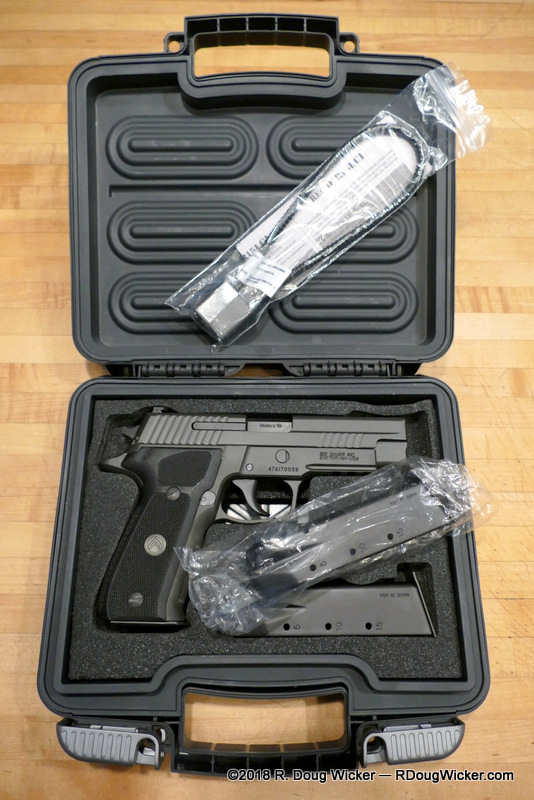
SIG P226 Legion in original factory hard-shell plastic case

In my view, the SIG P22(x) series of pistols are about the best built handguns currently on the market at their price point. You’ve seen me review some of these pistols before (see: SIG P220 Equinox — Beauty is More than Skin Deep and SIG P229 Enhanced Elite — An Exercise in Indulgence). Sure, I’ve heard the griping about a supposed reduction in quality control since most production was moved from Germany to the U.S., but I’ve yet to see that in any SIGs I’ve fired. They’ve all been rock solid. At the apex of the SIG P22(x) line is their Legion series. Today I present a first look at the SIG P226 Legion, this particular one in my preferred double-action/single-action trigger configuration as opposed to single-action only.
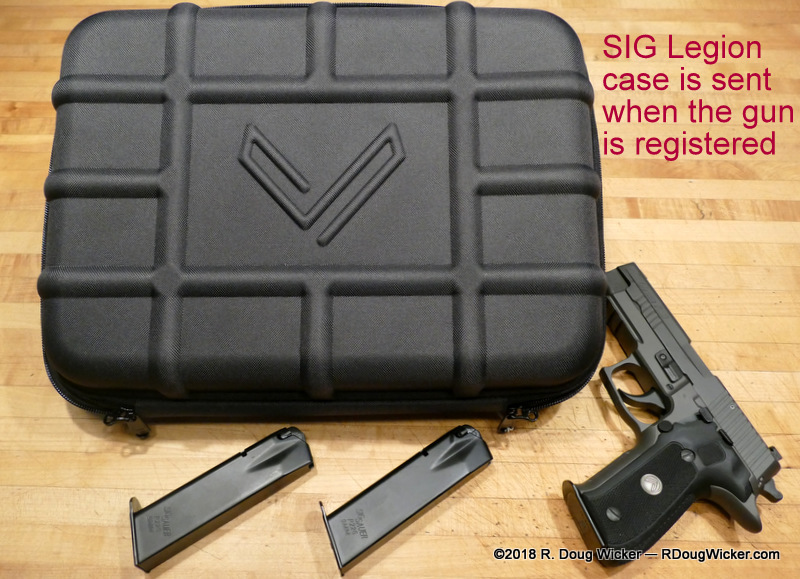
SIG Legion thermal case; sent free of charge once your Legion is registered with SIG

The Legion and three magazines come enclosed in SIG’s standard hard shell plastic case. When the gun is registered with SIG, you will receive in the mail an upgraded “thermal” case with a “challenge” coin that is matched to the pistol variant you purchased. For instance, the coin below is stamped “P226” and displays an image of the double-action/single-action variant. The reverse side of the coin replicates the Legion medallion on the grips and on the thermal case. The thermal case even includes a removable cutout for the optional, additional charge (at a hefty $499.95) SIG XM-18 Rick Hinderer knife.
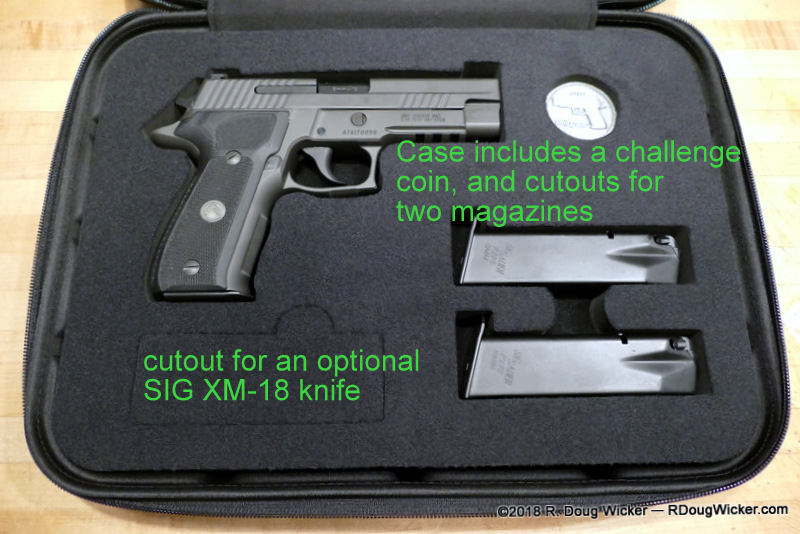
 

SIG Legion thermal pistol case and P226 DA/SA coin

As previously mentioned, the SIG Legion comes with three magazines. That’s something I wish all gun manufacturers included, but which I’ve only seen with regularity coming out of SIG and FNH.
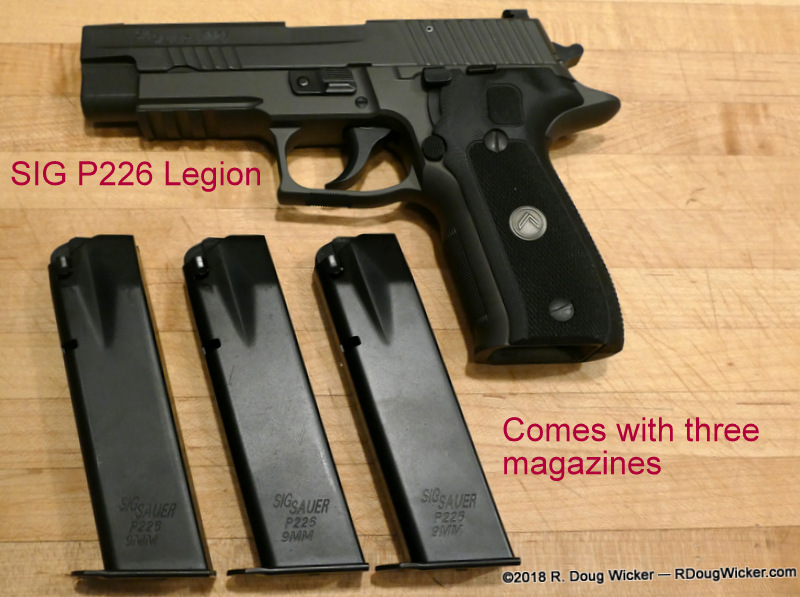
SIG P226 Legion comes from the factory with three magazines

The pistol itself is finished in a dark grey PVD (Physical Vapor Depositon) finish that, unfortunately, developed a reputation for flaking off in early examples released to the public. Later production examples appear to be more resilient, according to online comments.
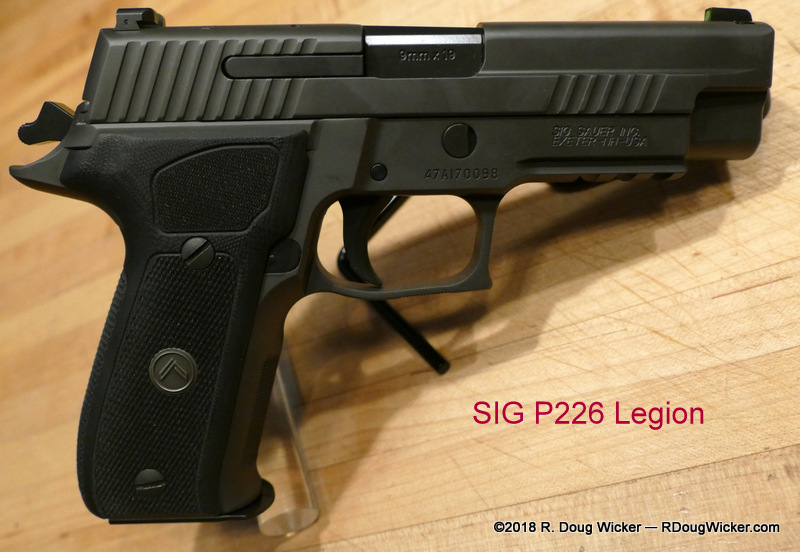
SIG Sauer P226 Legion

The controls on the double-action/single-action are classic SIG. The slide stop, decocker, take-down lever (above the trigger guard), and magazine release button are pictured below. On the single-action only variant, the decock lever is missing, and a 1911-style thumb safety is placed directly behind the slide stop.
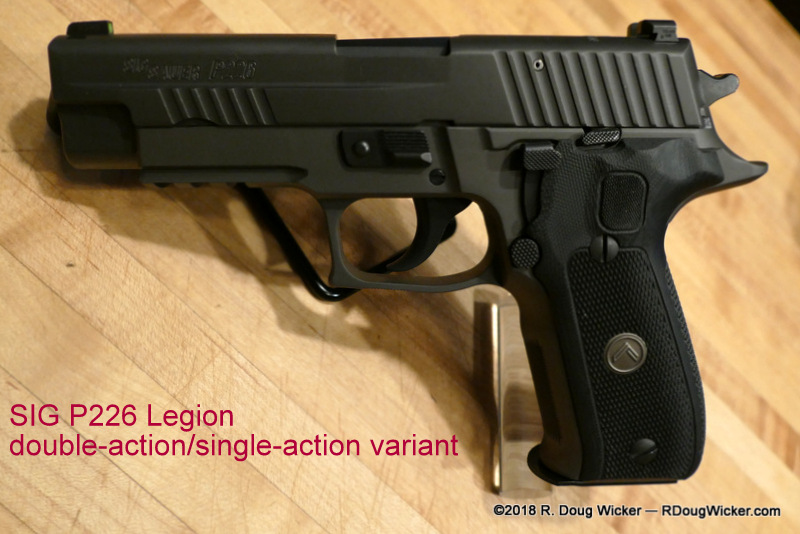
SIG Sauer P226 Legion

The Legion comes with black G10 grips upon which is embedded the Legion medallion.
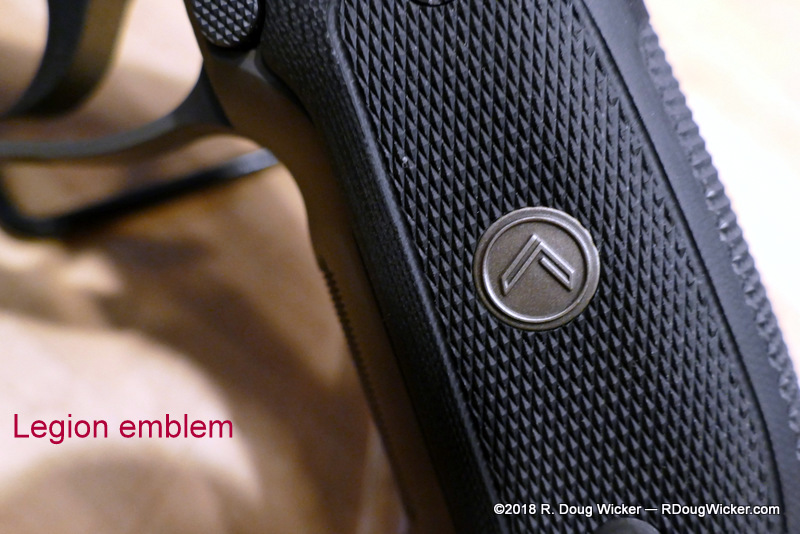
Black G10 grips with Legion medallion

SIG installs on the Legion some very good sights. These are the SIG X-RAY3 sights that were engineered by SIG’s Elector-Optical division. This resulted in the sights initially receiving a rather confusing and misleading designation of “Electro-Optical X-RAY3 sights”, as there is nothing either “electro” or “optical” about them. They are, however, excellent day/night tritium-filled rear sights with a tritium-filled fiber optic front sight. Visibility is reportedly exceptional in all lighting conditions, and from my perspective I have to agree. They’re simply great in both dark and bright light situations, although the photo below does a poor job reflecting that on the rear sight.
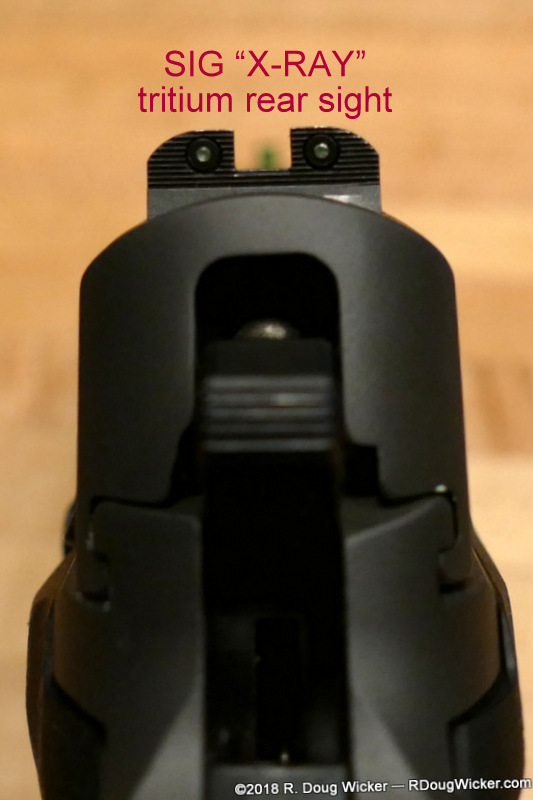
Rear X-RAY3 sight
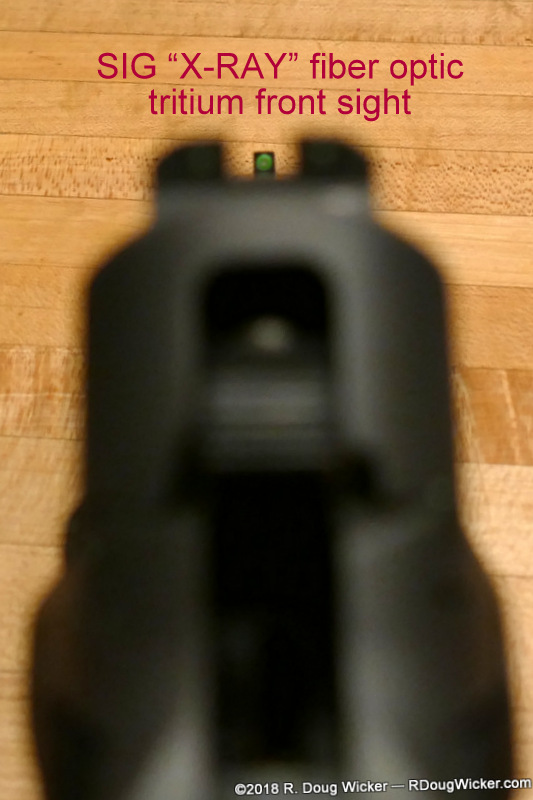
Front X-RAY3 tritium fiber optic sight

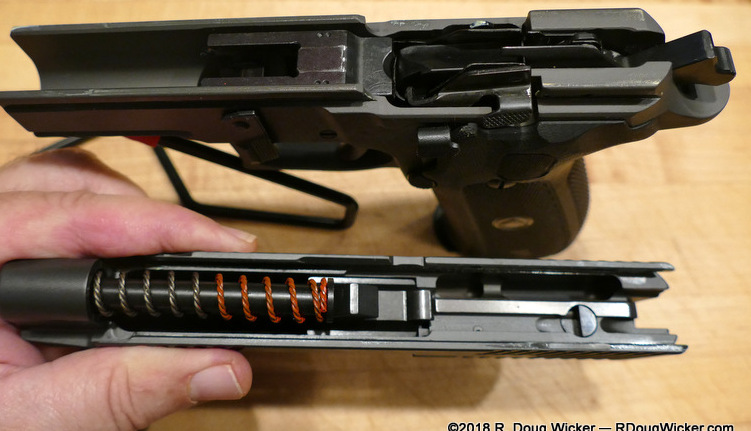
Disassembly is SIG simple. Lock back the slide, rotate the take-down lever 90° clockwise, disengage the slide stop, and pull the slide forward off the frame rails.
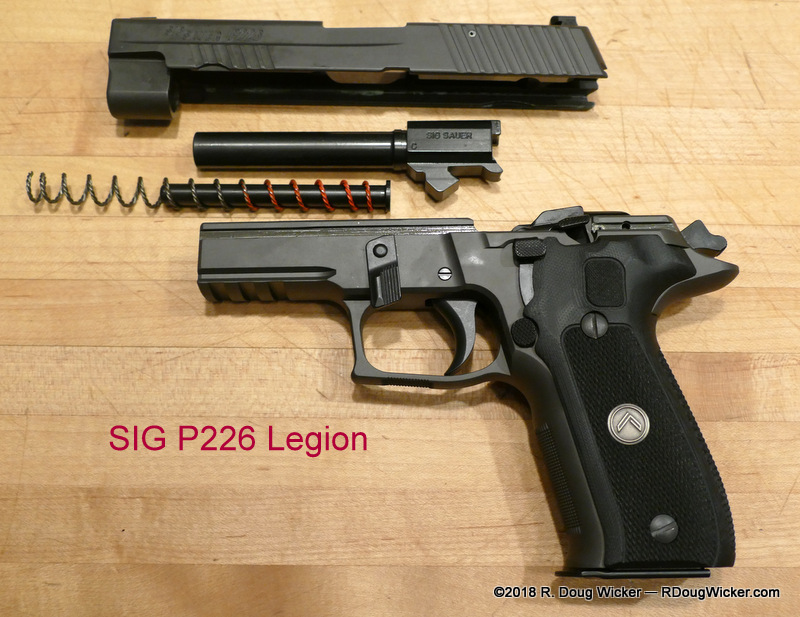
SIG P226 Legion disassembled (note the rotated take-down lever)

The trigger is exceptional, as is pretty much the case with any SIG P22(x) series double-action/single-action or single-action only pistol. But in the case of the Legion series, SIG have gone a step beyond. They’ve incorporated into the Legion an enhanced, polished, P-SAIT (P-Series Precision Adjustable Intermediate Trigger) short-reset trigger designed by Grayguns. As the name implies, the P-SAIT has an adjustment for over-travel.

SIG have also installed into the Legion series a solid-steel guide rod, which increases mass in an effort to reduce felt recoil and muzzle-flip. These are, after all, target-grade competition pistols.
Solid-steel guide rod

The price for entering the Legion club may seem exorbitant at first, but that’s only until you start adding up the cost of all the included extras. A stock P226 with nitron finish and SIGLIGHT tritium sights has an MSRP of $1,087. The P226 Legion is listed at $1,413. X-RAY3 sights for the standard P226 would be a $159.99 upgrade, then throw in the G10 grips at $109.95, the solid steel guide rod in black at $30, the short reset P-SAIT trigger at $39. Add all that up and your stock P226 is up to $1,425.94, and you still don’t have the PVD finish, the special Legion case and coin, or the Legion medallion embedded into your G10 grips.

Put all that together and that additional $326 over the initial price of a stock P226 begins to look like a real bargain.

Comments Off on First look at the SIG P226 Legion

Filed under Firearms, R. Doug Wicker

First look at a Rock Island Armory Ultra FS in 10mm


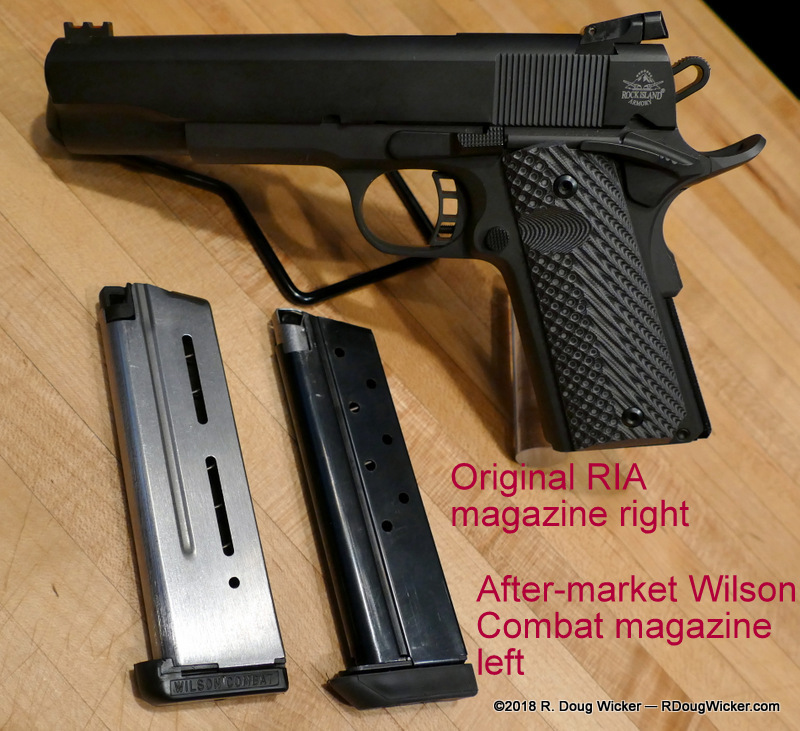
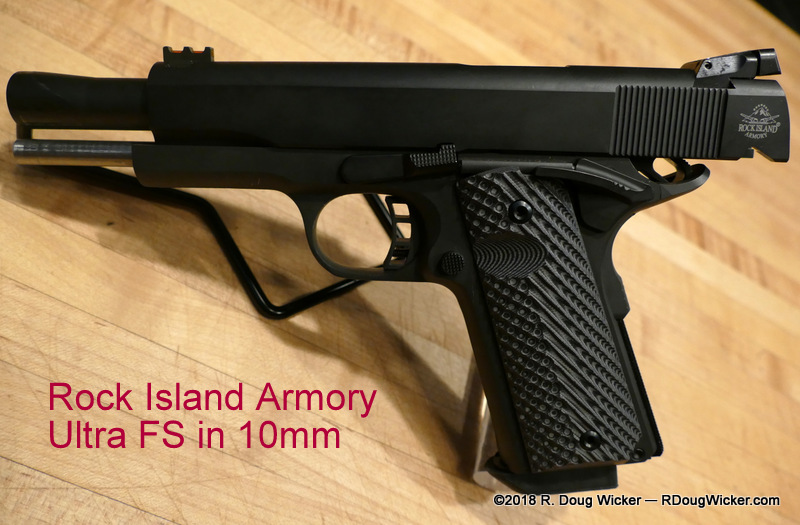
Rock Island Armory Ultra FS 10mm

People tell me that 10mm is a fun cartridge to shoot, especially out of a 1911-style pistol. I’ll let you know when I get around to trying it, but for now I’m just going to give my first impressions an a used 10mm 1911 from Rock Island Armory. Rock Island Armory have no connection with the famed U.S. Army Rock Island Arsenal. This Rock Island Armory is a subsidiary of Armscor, and is located in Marikina, Philippines.

Rock Island Armory Ultra FS 10mm

Rock Island Armory (RIA) is known for making an affordable (read: cheap) yet reliable 1911 copy. In other words, it’s a good bargain, and if you’re buying something for only occasional use and which you don’t care if it gets beat up in a holster while hiking in the woods, then cheap and used are the way to go. Thus, the RIA Ultra FS 10mm you see here today.

Rock Island Armory Ultra FS 10mm

That’s not to say that there aren’t problems with the RIA’s 10mm. Fortunately, reliability isn’t one of them, according to most reviews. What reliability issues I have seen reported appear to be what would normally be expected during break in of a new pistol using a very powerful cartridge. Finish, however, isn’t up to Colt standards. But, then, neither is the price. A new RIA Ultra FS 10mm comes in at around $300 to $400 less (street price) than the Colt Delta Elite. And for that cost advantage you get the added benefit of having a fully supported chamber, which may hold up better when firing full-powered 10mm loads. There are reports of catastrophic case failures with the unsupported chambers of some 10mm pistols such as the Delta Elite, but I’m not convinced that isn’t more attributable to home reloaders pushing the envelop on an already powerful cartridge.

Rock Island Armory Ultra FS comes with only one magazine

Another difference compared to the Colt Delta Elite is the addition of a bushingless barrel, which supposedly improves barrel-to-slide fit, thus increasing accuracy. The bushingless design also requires a wider “bull” barrel, which slightly increases mass and thus may reduce felt recoil. However, I doubt that the very slight increase in mass here would be enough to result in any real benefit in this regard.

Bushingless design

Note the wider bull barrel at the muzzle end

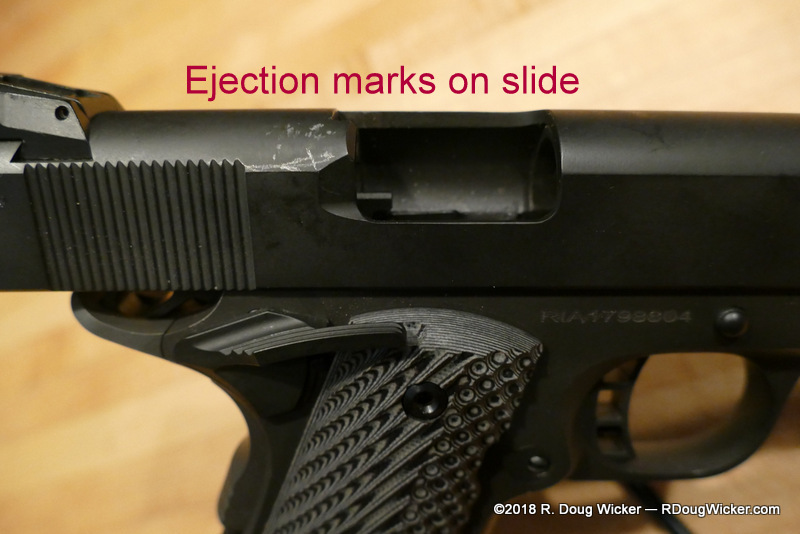
You can see from the following photograph this particular 1911 has a tendency to eject the casings in such a manner that they strike the upper portion of the slide behind the ejection port. Again, not something I’m very worried about, and I could probably remove those marks without marring the Parkerization.

Ejection marks

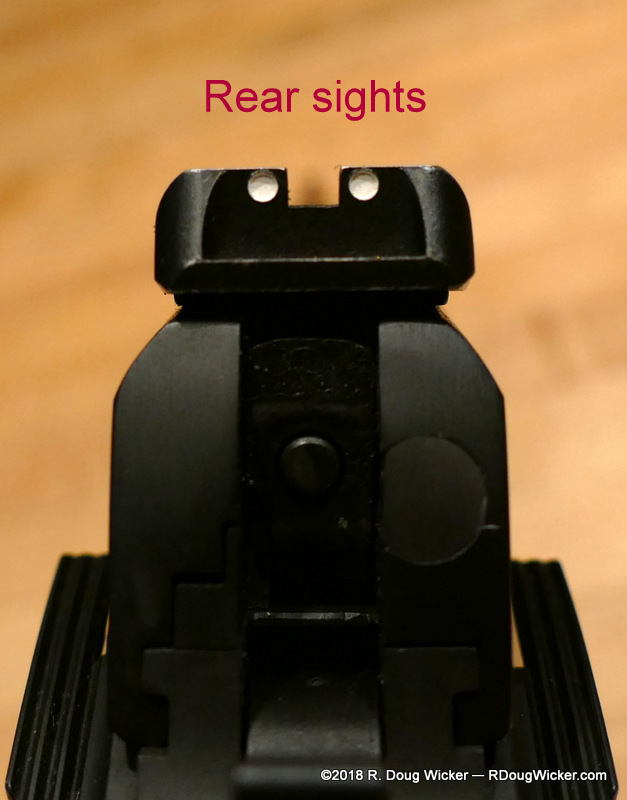
Rear sights are adjustable.

Adjustable rear sight

The front sight is fiber optic. Nice touch! Together, here is what you see looking down the slide:

Rear sight

Fiber optic front sight

Watch for a firing review after I get this thing to the range.

Comments Off on First look at a Rock Island Armory Ultra FS in 10mm

Filed under Firearms, R. Doug Wicker

Fun Firearms Friday — Pocket Pistol Shootout: Colt Mustang vs. Beretta Tomcat


Left to right: Walther PPK, Beretta Tomcat, PPK/S, Colt Mustang

I hope you’ve enjoyed Pocket Pistol Week here at the blog, but now it’s time to determine a winner. The 9mm P99c AS by Walther remains my primary concealed carry weapon, and it will continue in that role. But sometimes you simply need something just slightly more compact than the (in my opinion) best concealed carry weapon ever made, and for years my go-to choices for this were the Walther .380 ACP PPK/S for winter and the .32 ACP PPK for summer. Let’s look at the relevant numbers:

Walther PPK/S:

  • Length: 6.1 inches/155mm
  • Width: .98 inches/25mm
  • Height: 4.3 inches/109mm
  • Weight with empty 7-round .380 ACP magazine/9mm kurz: 23.6 ounces/669 grams

Walther PPK same as PPK/S above except:

  • Height: 3.8 inches/97mm
  • Weight with empty 7-round .32 ACP magazine: 22.1 ounces/627 grams

Colt Mustang Lite:

  • Length: 5.5 inches/140 millimeters
  • Width: 1.06 inches/27 mm
  • Height with flat-based 6-round magazine: 3.9 inches/99 mm
  • Weight with empty 6-round .380 ACP/9mm kurz magazine: 12.58 ounces/357 grams

Beretta 3032 Tomcat:

  • Length: 4.92 inches/125 millimeters
  • Width: 1.1 inches/28 mm
  • Height: 3.7 inches/94 mm
  • Weight with empty 7-round .32 ACP/7.65mm magazine:
    • Early thin-slide Tomcat 14.38 ounces/408 grams
    • Later wide-slide Tomcat 15.72 ounces/446 grams

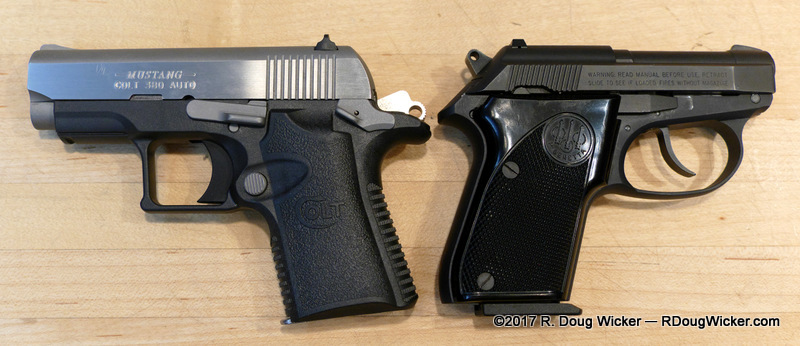
Mustang vs. Tomcat

As you can see, the Walther pocket pistols are noticeably larger and much heavier than the competition in today’s article, almost to the point that calling either a “pocket pistol” is really a misnomer by today’s standards. Between the Mustang and the Beretta measurements get a bit tighter, with the Colt coming out ahead in the weight category, and the Beretta clearly winning in length and height. The two pistols are virtually tied in overall width, but the much narrower slide of the Mustang makes it feel substantially thinner compared to the Tomcat.

Mustang vs. Tomcat length

Ergonomically the Mustang wins by a landslide. The button slide release on the Colt is where any experienced shooter expects, directly behind the trigger. And when pressed, the magazine falls freely from the grip magazine well. The Tomcat button release is much farther down the grip and located to the rear, making thumb manipulation with the shooting hand (for right-handers) very awkward. It’s actually easier to use the off hand to press the release, and when released the magazine stops dropping after just over a third of an inch of travel, about 10mm.  The Mustang also comes out on top with an ambidextrous safety and a slide that locks back on the last shot. The Tomcat’s only real win here is the ease of breech loading that marvelous tip-barrel rather than having to rack the slide. Further working in the Beretta’s favor here is the location of the barrel release lever above and slightly behind the trigger; its location is perfect for thumb activation with the shooting hand.

Mustang vs. Tomcat height

Triggers are pretty much a wash. The Mustang’s single-action only trigger is much stiffer than what one normally encounters in a 1911-type design. I’d estimate it at over seven pounds, probably approaching eight.  Reset is shorter, at about a sixteenth of an inch/1.6mm compared to three sixteenths/4.8mm for the Tomcat.  The Tomcat single-action trigger feels lighter than the Colt’s, but not appreciably so; probably around six pounds if I must guess (I really need to invest in a trigger gauge at some point for these articles).  As for the Tomcat’s double-action trigger, it’s better than the above cited Walthers, but it’s not very smooth and you can both feel and hear when the hammer passes the half-cock position. Despite its flaws, the Tomcat’s double-action trigger is more than adequate at self-defense ranges, and the Beretta has the added advantage of a cocked-and-locked option.

Mustang with 7+1 magazine vs. Tomcat height

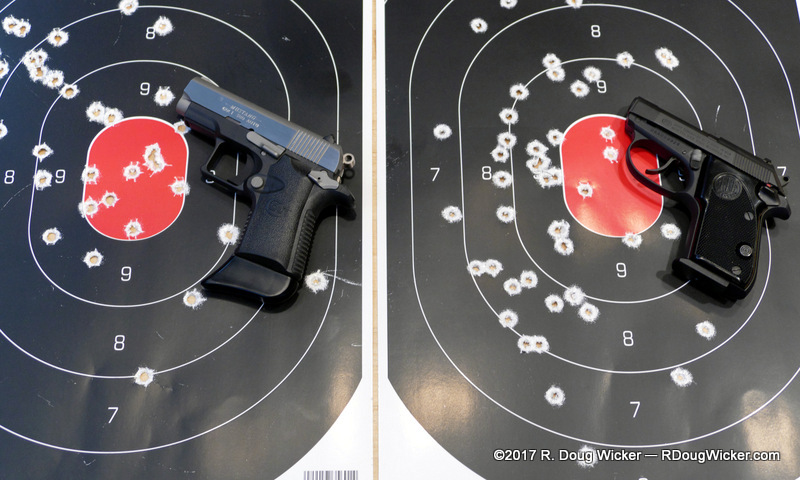
I’m going to grant a tie in the shootability between the Mustang and the Tomcat. Both have atrocious sights. Both are very mild in the recoil department, the Mustang being surprisingly so considering the more powerful .380 ACP in a lighter package. Because of their light recoil characteristics, both are extremely quick at reacquiring the target for follow up shots, or would be if the sights were actually up to that task. With factory magazines the Tomcat comes out ahead for two reasons.  First, the Tomcat is 7+1 versus 6+1 for the Mustang, although there are 7+1 magazines available for the latter at the expense of an extra inch of height.  Second, the Beretta’s factory magazine actually worked. The Colt’s did not, as the rounds nose-dived into the feed ramp so badly I couldn’t even get a round chambered until I switched to the three after-market Metalform seven-rounders I’d brought with me to the range.

Targets — Colt vs. Beretta

Both the Tomcat and the Mustang are quality pistols at comparable pricing.  Indeed, the Mustang would be my choice for a mini-1911 pistol in .380 ACP when compared to higher priced offerings from SIG (P238) and Kimber (Micro 380). The Mustang is lighter and less expensive than either, although I do like the SIG’s night sight option.

Walther PPK over Beretta Tomcat; PPK/S over Colt Mustang

Tomcat overlying PPK; Mustang atop PPK/S

So, bottom line, which weapon wins in the battle to replace the PPK and PPK/S as an alternate carry to the Walther P99c AS? Surprisingly to most having read this, I’m going with the Beretta Tomcat for several reasons:

  • I like being able to safely decock the weapon without having to clear the chamber
  • I’m more accustomed to double-action/single-action, and feel safer with the added resistance necessary to pull the trigger in double-action mode
  • For accuracy shots at beyond 21 feet, the hammer can still be thumbed back to place the weapon in single-action
  • The Tomcat still provides me with single-action cocked-and-locked capability if I so choose, whereas the Mustang only gives me that one method of carry

On a cold winter day, I’ll probably consider going with the Mustang for better penetration of heavier clothing, but in those cases the 9mm, 10+1 P99c AS is going to be easy to conceal anyway so the need to carry a smaller weapon is less likely to arise.

The Overall Winner in the occasional deep-concealment carry sweepstakes — Beretta’s .32 ACP 3032 Tomcat.

2 Comments

Filed under Firearms, R. Doug Wicker