The Rule of Thirds. It’s Not Just A Rule; It’s the LAW!


Okay, you’re impatient. Who isn’t nowadays?  You want to take better pictures now.  You don’t want to read the instruction manual that came with your camera.  You don’t want to learn about f-Stops, and white balance, and ISO, and shutter speed, and depth-of-field, and hyperfocal distances.  In fact, if you’re like most people, you don’t even want to take the time to learn your camera’s built-in features that help it to work optimally when in automatic mode.  You just want to take great pictures now, and learn all the rest of that techy, brainy junk later (yeah, riiight . . . we all know how fast “later” gets here; let’s be honest, most of us will never get around to learning this stuff).

Well, this one tip will do more to enhance your photographs than a whole library of photography books gathering dust on your bookshelves will do for you in a decade of haphazard browsing and half-hearted referencing.

It’s called “The Rule of Thirds.” It is in my opinion the single most important rule for the creation of interesting, attention-getting, Wow—your-camera-really-takes-great-pictures responses.  And in this case it isn’t even the camera that deserves the credit.  It’s you.

Most people just grab their camera, zoom in on their intended subject, place that subject front-and-center, smack-dab in the middle of the frame, and snap the shot without so much as a second thought.  And why not?  After all, isn’t that the whole raison d’être for a fully automatic camera?  Well, no, it’s not.  Placed in full-automatic, the job of your camera is to analyze the scene and light situation, guess to the best of its ability what you’re trying to photograph and how you want it to look, then set for you the camera’s ISO, shutter speed, aperture, white balance, and focus (all in a very impressive fraction of a second), and then snap the shot.  No matter how sophisticated the camera, it remains your job to select the subject and compose the picture in an interesting way.  Putting the subject in the middle of the frame and snapping away is usually not going to accomplish this feat.  Not even close.  Let’s take the time to do it right, shall we?

As you look in the viewfinder or the LCD screen, imagine two vertical and two horizontal lines dividing the scene into a grid pattern of nine equally sized blocks.  Better yet, if you have a camera that will superimpose such a grid on the screen for you, by all means set the camera to do so.  Now, that center block you either imagine (or see, if you just set up your camera)?  Do not place your subject in that box.  If the subject is tall (such as a building) line it up on along one of those vertical lines.  If your subject is, say, a landscape, superimpose the horizon underneath either the upper or lower horizontal line and off-center the main subject to one of the vertical lines.  Better yet, put the subject of the photograph at the intersection of a vertical and horizontal line.

Great pictures—the secret is all in the composition. Imagine a beach scene that includes a faded, peeling, rustic wood dingy.  If you’re like most people, you zoom in on that dingy until it practically fills the frame.  You get home, upload the picture to your computer, display it on the screen and what do you have?  You have a boring shot of an old wood dingy with absolutely no context as to its environment.  Now let’s do the same scene artistically.  Where the beach meets the waterline?  Let’s place that somewhere close to the lower horizontal line.  The horizon, where tropical blue water meets clear cerulean sky?  Let’s place that near the upper horizontal line.  Now, what about that dingy?  That goes as close as possible to one of the four “sweet spots” where horizontal line meets vertical.  Voilà.  A veritable masterpiece, as long as the camera did its job.

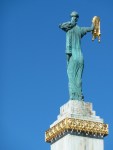
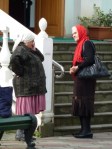
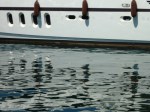
Let us take a look at some examples of the rule of thirds in action:

Notice that in many cases I had to zoom back, away from the primary subject of the film, in order to get the optimum placement and overall composition.  You must be willing to sacrifice close-in detail to achieve a truly interesting shot.  What you’re doing is incorporating the negative space near the subject—be that space sky, water, rocks, or whatever—and using that negative space to “frame” your subject and to give it context to its environment.  This adds background, depth, and most importantly interest to the overall photograph.  And, even though your subject is no longer in the center, the negative space if properly used acts to draw the eye of the viewer away from the center and toward the subject.  Simply put, that means you’re making the viewer visually interact with the photograph.

How about that . . . . An interactive medium that is static by nature.  Who would have thought?

6 Comments

Filed under Photography

L’arnacoeur (Movie Review)


L’arnacoeur (Heartbreaker)

Romantic Comedy, French, 2010, 104 minutes, directed by Pascal Chaumeil

Medium:  Netflix Streaming (Available on DVD)

Rating:  4.0 (5-point system)

Alex Lippi (Romain Duris) is in business with his sister Melanie (Julie Ferrier) and brother-in-law Marc (François Damiens).  Together, they are a formidable, never-fail team of professional relationship breakers.  Suspect that your daughter’s boyfriend is a skirt-chasing louse?  Think your son is dating beneath his station?  Want to wrest your former boyfriend from the clutches of your ex-best friend?  Alex, Melanie, and Marc are your go-to people . . . for a hefty price.  But they won’t break up just any couple.  They’ll only agree to break apart people who are truly not made for each other or who are otherwise unhappy in their relationship.

That is until Alex gets in trouble with his bookie and the bookie’s huge enforcer Goran, who enjoys dangling deadbeats over balcony railings until they promise to pay up.  €30,000 Euros of debt and a ten-story encounter with Goran convince Alex to loosen his principles when a Mr. Van der Becq offers to hire the team for €50,000 to stop the rapidly approaching nuptials of his daughter Juliette (Vanessa Paradis) to Englishman Jonathan (Andrew Lincoln).

The trouble is that Juliette and Jonathan truly are the perfect couple.  How good is the kind-hearted Jonathan?  In one memorable and very funny scene, the team (with Marc disguised as a homeless street person) spy on Jonathan and Juliette from outside an expensive restaurant.  When they observe Jonathan asking for a doggie bag, they conclude he is too cheap for the fair Juliette.  Alas, when the couple exits the restaurant, Jonathan steps over to the apparently down-and-out Marc and hands him the doggie bag for his meal.

Despite his ethics, Alex pressures Melanie and Marc into taking the job.  Now Alex has only days to intercede before the peal of wedding bells, desperately trying to pry apart a perfect couple all the while dodging the lumbering, hulking, ever-present Goran.

It’s all a lot of fun with beautiful Monte Carlo serving as the film’s glitzy canvas.  Elegant people, glamorous fashion, breathtaking views, and flashy cars abound as the scenery flashes by as quickly and with as much class as the Ferrari Alex “borrows” to impress his Juliette.

Thank you, Jason G. Anderson of Word Pursuit.  It appears I have a new fan.  Jason just yesterday posted on his blog Word Pursuit a review of Decisions.  How impressed was Jason?  Impressed enough to score Decisions at 4.5 on his blog.  And since Amazon doesn’t allow fractional reviews, Jason has announced that he’s rounding his score up to a perfect 5 when he posts his review on the Decisions Product Page.

Tomorrow’s The Big Day: Look for Decisions to be featured on Daily Cheap Reads, a site dedicated to finding and publicizing books priced at $5 or less for budget-conscious Kindle users.  It’s slated to go up at 5 p.m. Central time.  Thank you, Paula Haataja.

And One More: Fellow indie author Linda S. Prather has scheduled a mention of Decisions in her blog Linda S. Prather-Author.  She expects that entry to run either tomorrow or Wednesday.  Thank you, Linda.  Looking forward to it.

Comments Off on L’arnacoeur (Movie Review)

Filed under Movies

Take Twice the Cash and Pack Half as Much . . .


. . . or lose half your packed clothing along the way. We travelers have all heard that old saw, but none of us ever follow it.  This becomes especially evident when it comes time to purchase and pack the booze and souvenirs at the dreaded end of the trip in preparation for the long flight home.  Fifty pounds maximum (or less!) per bag?  Two-bag (or even one!) limit per person?  Who the heck are these airline people kidding?  Have they no shame?  What’s next, a mandatory gratuity to pay for the flight attendant?  An up-charge for an experienced cockpit crew?  Oooops.  Hope I didn’t just give some airline CEO a couple of ideas.

But before our last trip Ursula, my lovely wife of over thirty-one years, came up with a very elegant solution.  Facing a nine-day cruise out of Barcelona followed by a three-day trip to her home town of Zurich, and confronting the prospect of trying to bring back four liters of Swiss kirschwasser (a cherry brandy essential in the making of traditional fondue), assorted chocolates for both us and the kids (who placed their rather extensive orders beforehand), and even lugging back five kilograms (eleven pounds!) of Raclette cheese, all the while staying below the airlines’ baggage weight limits and within the volume confines of only two medium-sized pieces of luggage, she simply had to get creative in the pre-trip planning.  And creative she indeed was.

Her solution?  Pack old clothing we would be willing to leave behind.  So out came the stuff slated for the thrift store—stuff such as leisure suits, bell-bottom pants, and tie-dyed shirts.  Well,I exaggerate . . . but not by a whole heck of a lot.  Let’s just say that somewhere aboard the NCL Jade is a very happy room steward who is dress-ready for Disco Night.

As for that ‘amount-of-cash-to-bring-along’ thing?  You’re on your own on that one because we still haven’t figured that out, to which our credit card company can both readily and happily attest.

Last spring, in the name of research for my current writing project, we made the ultimate sacrifice for my readers and took up living on a cruise ship for the better part of two months.  During that fifty-four-day sojourn I kept almost 2,700 photographs (probably deleted almost twice as many!).  During the cruise we had a photo contest in which passengers could enter one photo into each of three categories:  Landscape, Architecture, and People/Animals.  No post processing was allowed; you had to go with the images straight out of the camera.  What follows are nine photographs I took during the voyage.  Three were entered in the aforementioned contest, one per category.  See if you can figure out which three were entered, which took a first-place win, which placed third, and which didn’t place at all.

Best of luck:

4 Comments

Filed under Photography, travel