Category Archives: travel

Istanbul in Words and Pictures


Today’s intended blog has been preempted by an information request from my literary agent.  He’s going to Istanbul this summer, and he wanted some tips on the sights and things to do.  So, today’s blog will deal with intriguing Istanbul, with a little photography thrown in as well.  Henry, my friend, this blog’s for you:

My wife Ursula and I visited Istanbul over two days last April.  As it turns out, I wish the visit had been longer.  There is just so much to see and so many things to do.  Alas, we were on a cruise and two days was all we were allotted.  Istanbul is a city that spans both sides of the Bosporus Strait, thus it is in two continents—Europe and Asia.  The city is further divided on the European side by the Golden Horn, a natural harbor on the European side of the Bosporus.  The “old” city is built upon seven hills on the south side of the Golden Horn, and it is there where the most historic sites and exotic locales reside.  If your time in Istanbul is limited, this area should be your base of operations during your stay.  Let’s take a look at some of the sights in this area:

Sultan Ahmed Mosque or, by its more famous name, the Blue Mosque is an incredible structure that was completed in 1616.  The most notable external architectural features include the 140-foot-tall dome and the six statuesque, pencil-shaped minarets, two of which are separate from the main structure.  But as impressive as the outside is, the inside is even more spectacular beneath the great dome that towers at an incredible height overhead.  Inside you are greeted by over 20,000 hand-made tiles laid in a multitude of artistic patterns, including the blue tiles lining the underside of the main dome that give the Blue Mosque its popular name.
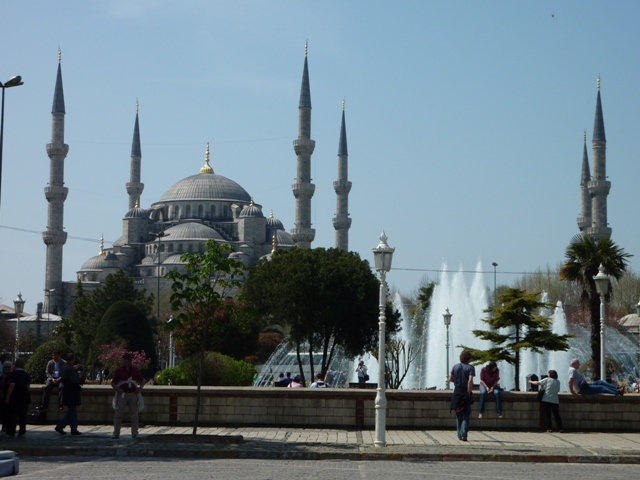
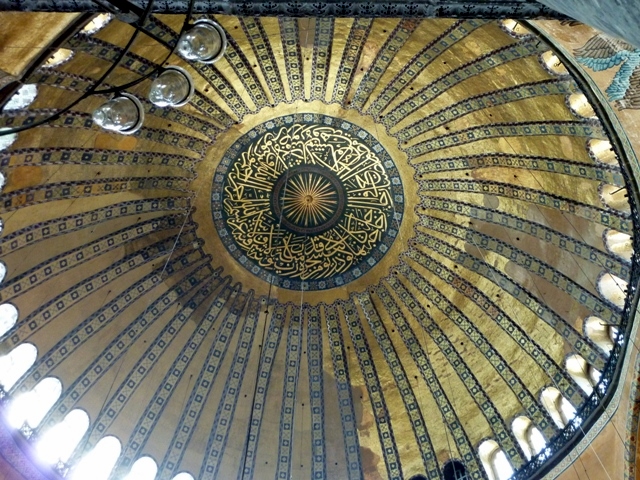
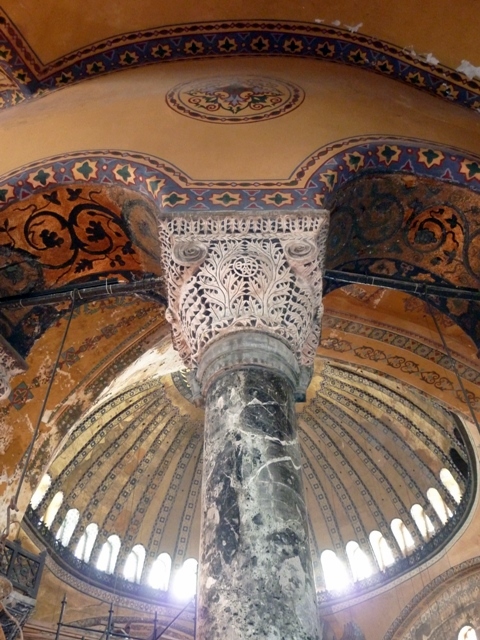
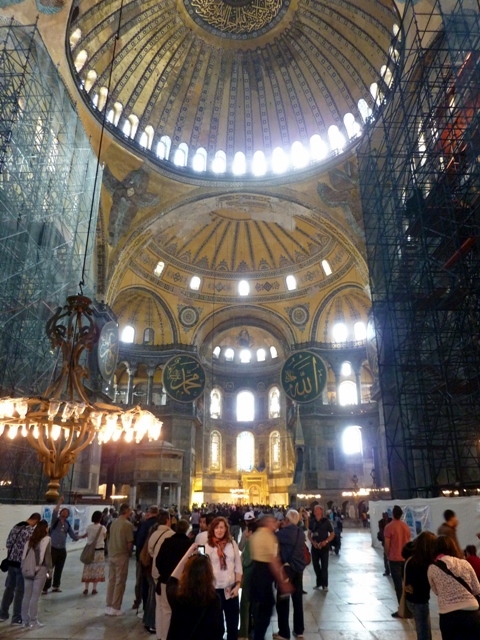
The site upon which sits the Hagia Sophia, just a short walk from the Blue Mosque, has been home to religious structures since AD 360 and was originally an Eastern Orthodox basilica.  The current structure is the third to be built there, and was completed in AD 537.  Earthquakes soon undermined the dome, resulting in its collapse in AD 558.  The dome reconstruction was completed in AD 562, and from that time until 1520 the Hagia Sophia was the largest cathedral ever built.  But from 1453 until 1935 it was no longer a cathedral.  Following the Ottoman conquest the Hagia Sophia was converted into a mosque, and in 1935 it became a museum highlighting its classic Byzantine architecture and incredible Christian mosaic tile depictions of religious figures.  Make sure you take a stroll into the upper gallery.  And while you’re up there, look for a great photo opportunity that captures the Blue Mosque framed by domes on the Hagia Sophia.

The Basilica Cistern is less than three minutes’ walk from the Hagia Sophia and well worth the price of admission.  Deep below the streets of Istanbul, an army of 336 marble columns standing like soldiers on the parade field and reflected in the water surrounding them present you with some really great Kodak moments.  Make sure you trek to the back of the cistern.  There you’ll find two columns with Medusa-head bases.  One Medusa head lies on its right side; the other upside down.


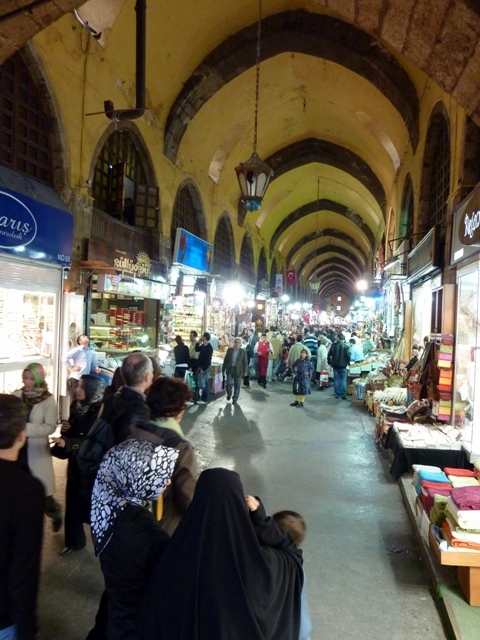
Take in the Grand Bazaar. There you will find an incredible array of spices, gold jewelry so brightly lighted and sparkling that it will dazzle you, intricate hand-inlaid backgammon and chess boards, lamps using glass in every color imaginable, and much, much more.  Don’t be shy with your camera, but make sure you ask permission before photographing any of the vendors or their wares.  You’ll almost never get a ‘no’, but you may be chastised if you don’t ask beforehand.  Many vendors will even pose with you while others snap the shot for you.  And, no, you needn’t worry about thieves as you would in pickpocket-rich Athens, Rome, Barcelona, or many other European cities.  Istanbul is a place where you will never feel safer from these types of petty but irritating and inconvenient crimes.  Chalk this up to the Islamic code of justice and a friendly people who take pride in their city and what travelers think of it.
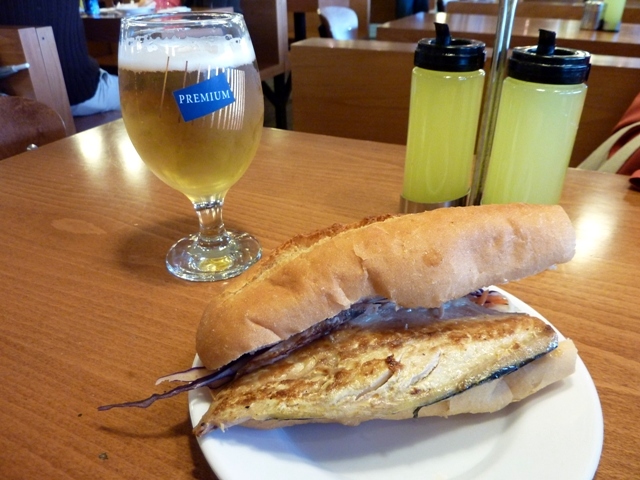
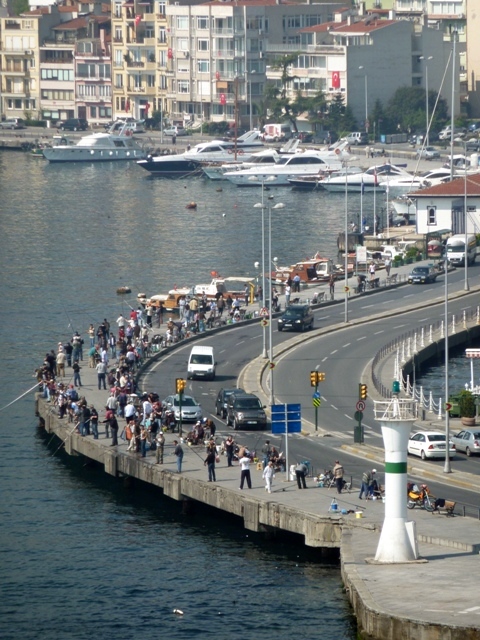
The Galata Bridge spanning the Golden Horn and connecting old Istanbul to new is a real treat.  Along the railing you will find a row of fishermen, poles jutting outward, lines in the water.  Buckets of bait and coolers holding lunch and soft drinks lay at many a fisherman’s feet.  Picturesque boats of every size, shape, and color pass beneath the center of the bridge, and restaurants and shops are built beneath it near either shoreline.  For lunch, try one of these restaurants for a great meal consisting of a sandwich containing fresh-caught Bosporus fish, European-style pomme frites (French fries . . . only a whole lot better than you’ll get nearly anywhere here) and an ice-cold beer.  Shop around and compare and your lunch tab will be less than what you would spend at a fast-food restaurant in your home town.

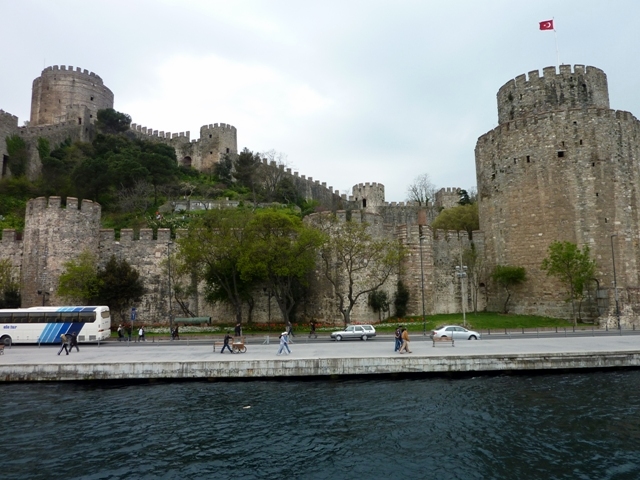
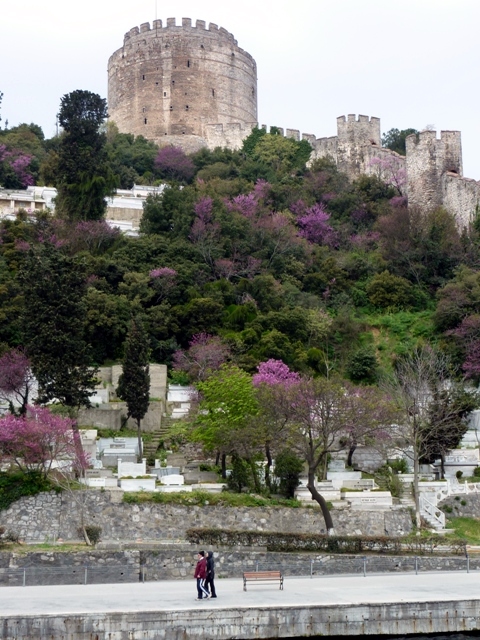
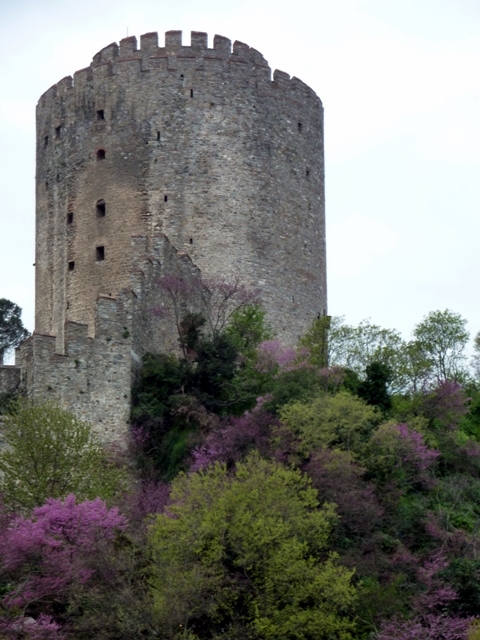
The best deal in town simply has to be one of the sightseeing boats that depart from the ferryboat docks on the south side (old Istanbul side) of the Galata Bridge.  The trip is one and a half hours of pure, peaceful, fun and picturesque photographic joy.  Along the way you will see the modern skyscrapers of new Istanbul in the background; the medieval castles that once guarded the Bosporus; palaces and homes of the rich, and mosques of every size, shape, and era.  You’ll pass beneath the dramatic and modern suspension bridges that connect Asia to Europe all the while dodging everything from ferries to freighters to fleets of small fishing boats and even multimillion-dollar yachts.

Topkapi Palace in Old Istanbul is the sight we did not see, but my fellow cruise companions raved about it.  It served as the residence of the Ottoman Sultans from 1465 until 1856 whenever they were in Istanbul.  Contained within its fortress-like walls are many buildings and four main courtyards.  There, inside, you will find treasures such as the sword of the Prophet Muhammed and priceless collections of weaponry, armor, jewels, and irreplaceable manuscripts done in artistically flowing calligraphy.  Make sure you pay the extra price required to visit the Imperial Harem and its 400+ rooms.  You could say that I was told it was a very eunuch experience, but that would just be so wrong on so many levels.

Thank You Linda S. Prather: Linda is just the latest in an ever-increasing list of bloggers to feature Decisions as you can see at:  http://jacodypress.blogspot.com/
Comments Off on Istanbul in Words and Pictures

Filed under Photography, travel

Take Twice the Cash and Pack Half as Much . . .


. . . or lose half your packed clothing along the way. We travelers have all heard that old saw, but none of us ever follow it.  This becomes especially evident when it comes time to purchase and pack the booze and souvenirs at the dreaded end of the trip in preparation for the long flight home.  Fifty pounds maximum (or less!) per bag?  Two-bag (or even one!) limit per person?  Who the heck are these airline people kidding?  Have they no shame?  What’s next, a mandatory gratuity to pay for the flight attendant?  An up-charge for an experienced cockpit crew?  Oooops.  Hope I didn’t just give some airline CEO a couple of ideas.

But before our last trip Ursula, my lovely wife of over thirty-one years, came up with a very elegant solution.  Facing a nine-day cruise out of Barcelona followed by a three-day trip to her home town of Zurich, and confronting the prospect of trying to bring back four liters of Swiss kirschwasser (a cherry brandy essential in the making of traditional fondue), assorted chocolates for both us and the kids (who placed their rather extensive orders beforehand), and even lugging back five kilograms (eleven pounds!) of Raclette cheese, all the while staying below the airlines’ baggage weight limits and within the volume confines of only two medium-sized pieces of luggage, she simply had to get creative in the pre-trip planning.  And creative she indeed was.

Her solution?  Pack old clothing we would be willing to leave behind.  So out came the stuff slated for the thrift store—stuff such as leisure suits, bell-bottom pants, and tie-dyed shirts.  Well,I exaggerate . . . but not by a whole heck of a lot.  Let’s just say that somewhere aboard the NCL Jade is a very happy room steward who is dress-ready for Disco Night.

As for that ‘amount-of-cash-to-bring-along’ thing?  You’re on your own on that one because we still haven’t figured that out, to which our credit card company can both readily and happily attest.

Last spring, in the name of research for my current writing project, we made the ultimate sacrifice for my readers and took up living on a cruise ship for the better part of two months.  During that fifty-four-day sojourn I kept almost 2,700 photographs (probably deleted almost twice as many!).  During the cruise we had a photo contest in which passengers could enter one photo into each of three categories:  Landscape, Architecture, and People/Animals.  No post processing was allowed; you had to go with the images straight out of the camera.  What follows are nine photographs I took during the voyage.  Three were entered in the aforementioned contest, one per category.  See if you can figure out which three were entered, which took a first-place win, which placed third, and which didn’t place at all.

Best of luck:

4 Comments

Filed under Photography, travel

A Twofer


Today begins my first true blog entry and you’re in luck.  It’s a twofer (real word, believe it or not).  Why a twofer?  Because the second part will address a recent Washington Post story dealing with my former career.

Part One: The Setting for Decisions

Decisions is set on the entirely fictional, privately owned island of Vai Kai in the Fijian island group.  I visited Fiji just over a decade ago, a couple of years before I began writing Decisions.  The Republic of the Fiji Islands consists of 110 permanently inhabited islands (some of which are indeed privately owned), 222 mostly uninhabited islands, and well over 500 islets (many of which disappear beneath the waves during periods of high tides or stormy weather). The name I chose, Vai Kai, is Polynesian for food and water.  I got the idea for the name from a friend of mine, Mark Vaikai, an air traffic controller whom I met in the control tower at Raratonga International Airport in the Cook Islands back in the early 1990s, and with whom I remain in contact to this day.  In all my world travels Fiji remains one of my favorite destinations.  I very much look forward to returning some day in the future.

Part Two: Don’t Read If You Fear Flying

The Washington Post reported on October 9 and again December 31 that U.S. air traffic controllers are setting all-time records in the number of operational errors (OE) reported nationwide.  An OE is when two aircraft come closer together than FAA separation rules allow.  Think of it as running a stop light at a busy intersection, or perhaps entering an Interstate Highway going the wrong direction.  Not good.  Sometimes you get away with that kind of error, but eventually it catches up with you.  FAA Administrator Randy Babbitt would have you believe that the increase in error rates is because of increased reporting following the implementation of a new self-reporting system that grants immunity in exchange for the gathering of data to be used to improve overall system safety.  Worse, he touts the myth that the system has statistically never been safer.

Balderdash (because this is a family-friendly blog).

To paraphrase a line in a book I wrote on the subject (and which New York publishing houses found, “too terrifying,” to publish—the exact words on at least one rejection), “An absence of death is not an indicator of safety.”  Never has been.  Hopefully never will be.  Just because Joe Davidson has ridden his Harley without a helmet for ten accident-free years does not mean that Joe is doing something safe.

OE rates were climbing well before Administrator Babbitt’s system was implemented, and well after previous Administrator Marion C. Blakey signed off on a plan that reclassified the least serious OEs as “Proximity Events.”  Yes.  You heard that right.  Even after the FAA magically wiped off the books the most frequent errors committed by controllers by magically renaming them something else entirely, the total number of errors actually increased even with those previous errors no longer counting toward the total.  And because the least serious errors are no longer classified as errors, that means that the errors currently being reported are much more dangerous and substantially more in number.

And why did Administrator Blakey resort to such creative accounting to show a decrease in operational errors?

Because of inept mismanagement bordering on the criminal.  Many in Administrator Blakey’s controller workforce were hired in the immediate aftermath of the PATCO controller strike in 1981, which at the time resulted in 11,000 of the nation’s controllers being fired.  Because of the incredible stress of the job, most controllers are eligible for retirement after serving 25 years.  Here’s some math that apparently escaped Administrator Blakey’s attention: 1981 + 25 = 2006.  In 2006 Administrator Blakey ordered controller base pay be frozen for five years.  In other words, she told an experienced, seasoned, and already dangerously understaffed workforce coming up on retirement eligibility that they could either have their wages eroded by inflation over the next five years, or they could retire and get annual cost-of-living adjustments to their retirement checks.

Today you have the inevitable result from that incredibly short-sighted decision.  The number of fully-qualified controllers in the U.S. last year fell to levels not seen since 1992, even as the nation’s air traffic numbers continue to climb in the wake of the recent Great Recession and subsequent but gradual recovery.  Many of the controllers who are fully qualified today have less than four years of experience and were trained under a system that lowered training standards to levels never before considered acceptable for that career field.  It is, quite frankly, an accident waiting to happen, and over the next decade hundreds, perhaps thousands, will die as a direct result.

3 Comments

Filed under Aviation Safety, travel