Category Archives: Technology/New Stuff

How Contracting Government Gets People Killed—Part II


Getting kind of ticked off, yet, after Part I?  In the continuation of this series, you’re going to see how you’re being duped into handing over to contractors somewhere between $20 billion and $40 billion for a system that cannot deliver on almost any of the promised benefits.  And in Part III you will see examples of why contracting out essential government services not only costs the taxpayers money, it also kills people . . . including—

Well, we don’t want to ruin the surprise, now do we.  So, let’s just get on with Part II for now (Remember that all facts cited were accurate as of 2008, and that most of this stuff has only gotten a lot worse since):

NextGen vs. NowGen

But first, what exactly is NextGen?  It will surprise the reader to know that there is no concrete definition—neither from the Agency pushing it nor the former Administrator who pinned her post-government employment opportunities upon it.  What it appears to be is several as of yet undefined technologies, but most notably it will probably wind up being something called ADS-B.  The Automatic Dependent Surveillance-Broadcast system is a method of deriving aircraft positions and altitudes via satellite and transmitting that information to the controller on a standard radar-type display.  The advantages of ADS-B over radar are unlimited range (standard airport radar is limited to a 60-mile radius; en route to about 200), increased accuracy (down to as little as thirty feet, or about ten times greater accuracy than long-range en route radar), and near-instantaneous, one-second position updating (versus a 4.8-second scan rate for airport radar and around 12 seconds for en route systems).

Sounds great.  So what’s not to like?  First of all, radar (RAdio Detection And Ranging) is actually two technologies rather than one.  Primary radar sends out radio frequency radiation which bounces off the aircraft and returns to the radar antenna.  Equipment then measure the time the signal took to return and the precise rotational angle of the antenna to determine the aircraft’s bearing and distance.  Very antiquated technology—dating back to English defenses during WWII—but it works well enough in the event that an aircraft loses its transponder.

Which brings us to the second type of radar, known logically enough as secondary radar.  This secondary radar system sends an interrogator signal to a device aboard the aircraft.  This device is the transponder.  The transponder encodes additional information such as altitude and, in newer Mode-S systems, the precise location as derived from GPS.  A secondary radar system interrogating a Mode-S transponder is thus just as accurate during the actual scan as is ADS-B, but once again that position report is not updated as frequently.

Once ADS-B is fully operational, the FAA plans to dismantle its expensive, maintenance intensive, nationwide network of airport and en route radar systems.  But there are a number of glitches to this plan:  All aircraft will need to upgrade to ADS-B equipment at the cost of perhaps hundreds of thousands of dollars per aircraft.  An aircraft not so equipped will be invisible to the controller.  Additionally, the GPS satellites are susceptible to interference by everything from solar activity, to meteoroid or space junk collision and damage, to intentional interference by jamming or, worse, anti-satellite missile activity.  Indeed the Chinese only recently tested with great success just such a missile on an obsolete weather satellite.

Even a lumbering bureaucracy can endanger GPS.  A recent GAO report shows that the Air Force because of mismanagement and underfunding is years behind upgrading and replacing aging GPS satellites.  According to the GAO, system degradation including region-wide GPS blackouts could very well begin starting in 2010.  And this is the technological basket into which the FAA wants to put all its eggs.  Marion Blakey and her hand-picked (although thankfully temporary) replacement Bobby Sturgell have all but ensured it.

Then there’s the 9/11 scenario:  After commandeering an aircraft a well-versed hijacker either switches off the ADS-B or, if such a switch is not incorporated for security reasons, goes to the circuit breaker panel and trips the breaker powering the unit.  In this event, with no primary radar to fall back on, the aircraft simply disappears from the controller’s screen.  The controller has no way of knowing if the aircraft crashed, diverted to a nearby airport, or is winging its way toward Capitol Hill during a joint session of Congress attending a speech by the President of the United States.  This is precisely the scenario which played out on September 11, 2001.  Hijackers aboard three of the four aircraft successfully commandeered that day disabled the transponders almost immediately.  On radar screens across the country those airliners quit transmitting position and altitude information.  Controllers were able to partially defeat this ploy however by falling back to their primary radar.  This resulted in the successful evacuation of several high-profile targets in the Washington, D.C., area (including the White House and the Capitol) before the crash into the Pentagon.

So, not only does NextGen fail in its primary stated role in reducing air carrier delays, it also degrades national security and leaves the country more vulnerable in the event of another 9/11-style attack.

Back to following the money.  Remember the date on which Marion Blakey’s tenure as FAA Administrator ended—September 13, 2007—and follow the chain of events in the months leading up to that date.

In June, with three months remaining in her five-year stint as administrator, Marion C. Blakey entered into negotiations with the Aerospace Industries Association (AIA) to take over the position of AIA president and CEO.

The Aerospace Industries Association announced on August 21, 2007, that their next CEO and President would be Marion C. Blakey.  She was slated to take the new position on November 12, 2007.  Her salary was not disclosed, but her predecessor in that position earned approximately $530,000 in 2005.  One can safely assume she will garner no less, and probably much more.  Blakey’s pay as FAA Administrator was $168,000.

Only nine days after the AIA announcement, on August 30, 2007, Administrator Blakey apparently reciprocated.  She announced that AIA member ITT had been awarded a $1.8-billion contract for initial development of NextGen.  The contract is highly controversial in that the FAA fronts much of the money for development on the system yet does not own it.  In fact under the terms of the contract the agency winds up paying a subscription fee on a system for which it paid a substantial portion of the development costs.  Final FAA costs are projected to be somewhere between $15- and $20-billion, with a like amount being paid by system users.  If past modernization projects are any indication then lax FAA oversight, mission creep, and unbudgeted system enhancements will double or triple this estimate.  The contract does not expire until 2025.

And what of Bobby Sturgell, Marion Blakey’s hand-picked successor?  Sturgell’s nomination by President George W. Bush to remove the word ‘Acting’ from his title of FAA Administrator was shot down in Congress by senators who had long grown tired of the ineptitude and outright corruption running rampant throughout the Agency’s upper management ranks.  Not surprisingly, he followed in his mentor’s footsteps and found his way to lucrative employment with yet another AIA member—Rockwell Collins—where he gained the title of Senior Vice President, Washington Operations.  According to Rockwell Collins’ website, Sturgell is, “… responsible for developing and implementing the company’s governmental, regulatory, legislative and industrial affairs strategies, and for maintaining relationships with Congressional members, staff and other administration officials.”  Put another way, he’s cashing in at taxpayer expense on the political connections he made when he was with the FAA.

And Sturgell’s qualifications for this high-paying, post-government position?  “Bobby’s extensive experience and strong working relationships, in Washington D.C. as well as the aerospace and defense industry, will help ensure we are well-positioned to provide perspective and insight regarding policy and legislation important to our business.”  In other words, Sturgell will lobby all those Agency ‘Vice Presidents’ which both he and Marion Blakey installed during their tenure at the FAA.

Rockwell Collins is a leading supplier of avionics.  They already supply almost all the onboard GPS navigation systems in use on Boeing and Airbus aircraft as well as Bombardier’s CRJ Regional Jets.  When NextGen and ADS-B become the reality that he helped ensure, Rockwell Collins stands to make a fortune retrofitting existing aircraft to ADS-B standards.

The Great AFSS Taxpayer
Rip-off of 2005

One should not walk away from this thinking that ITT is the lone AIA beneficiary of Administrator Blakey’s largesse.  Fellow AIA member Lockheed Martin walked away with a similar amount two years before—a ten-year, $1.9-billion contract.  That deal included Blakey handing over the keys to the government’s entire Automated Flight Service Station (AFSS) infrastructure (minus Alaska’s three stations, which Congress ordered the Agency to retain), long ago paid for with U.S. taxpayer monies.  This contract was supposed to save the U.S. taxpayer $2.2-billion over thirteen years (a curious claim for a ten-year contract).  That figure does not include $2-billion in continued FAA costs for personnel and equipment during the contract’s lifetime.  So, the actual anticipated savings to the government would be about $200-million, or about $80,000 for each of the 2,500 dedicated public servants whose lives were turned upside down, stripping from them—many within just a few years of eligibility—their retirements and financial futures.  Nevertheless, the keys to one of the three legs upon which this country’s air traffic system rests were turned over to Lockheed Martin beginning in October of 2005.  It’s been a downhill slide in service and safety ever since.

Contractually, Lockheed Martin is required to meet certain, specific, quantifiable performance objectives.  AFSS personnel have twenty seconds to answer an incoming telephone call.  On any given day, no more than five percent of callers are allowed to get a ‘busy’ signal.  Incoming radio calls from pilots must be answered within five seconds.  Flight plans must be entered error-free into the NAS computers within three minutes of receipt.  The AFSS briefer to whom a pilot is speaking must be trained in the area in which the flight will be conducted, meaning they are familiar with local airports (including current runway or taxiway closures, reduced services, or other potential impacts to flight safety), no-fly areas (military restricted airspace, presidential movement notices, etc.), weather phenomena, terrain, obstructions, and other ‘traps’ into which an unsuspecting pilot unfamiliar with the area might fall.  In each quarter that these criteria are met Lockheed Martin receives a $3-million bonus.

The reader will be interested to know that Lockheed Martin has never met almost any of its basic contractual requirements, yet only one quarterly bonus has been withheld by the FAA to date, and that was mischaracterized by many at the time as a ‘fine.’  Indeed, Lockheed Martin only recently has come anywhere close to the level of service that the FAA provided before the Agency relinquished this function to Lockheed Martin, yet Lockheed Martin continues to receive that quarterly $3-million bonus as if they were in full and complete compliance.  You’ll be shocked to see how Lockheed Martin managed to recently improve.  They did it by chasing away nearly 80% of the customers the FAA entrusted to them.  But more on that in a moment.

And the savings to the taxpayer?  Administrator Blakey announced within months of contract implementation that anticipated savings had dropped from the $2.2-billion initially promised to about $1.7-billion.  That estimate is still far too high because the Agency in its rush to contract out this function failed to account for several duties routinely performed by AFSS personnel.  Since these duties were not placed in the original contract, they have since been doled out to other FAA personnel and even other governmental agencies.  The costs associated with these transfers of duties are also not taken into account.  And since $2-billion of the original $2.2-billion estimate were already nullified by keeping off the books certain AFSS-related Agency expenditures, the taxpayer will actually wind up spending substantially more than had AFSS functions been retained by the government.

So, what are the consequences to lives, property, and national defense?  To answer this you must first know the primary function of an AFSS briefer.

Friday:  Part III

copyright © 2011 R. Doug Wicker

No portions of this article are to be used, quoted, copied, or retransmitted without the permission of the author.

Share on Facebook

3 Comments

Filed under Aviation Safety, Technology/New Stuff

How Contracting Government Gets People Killed—Part I


By far my most popular blogs have to date dealt with aviation safety, and the most popular of all was my three-part series on Why Southwest’s Boeings Keep Coming Apart Above 30,000 Feet (Links to Part I, Part II, and Part III of that series).  Well, you know what they say . . . don’t reward bad behavior.  Since my biggest “reward” in terms of viewership was that three-part series dealing with corruption, incompetence, and aviation safety, it was obvious all along to me that I would at some point have to try to duplicate that success.  And as with that previous series, this one is also derived from The Tombstone Agency, an expose I wrote back in 2008 but which was deemed by several New York publishing houses to be too terrifying to publish.

Lately, the conversation making the rounds on Capitol Hill is on the contracting out of essential government services in order to save money.  Don’t fall for it.  It’s been done before.  It didn’t save a dime (actually, it cost money, as you’ll soon see).  The only people to benefit were the shareholders of the company involved and the government employees who precipitated this fraud on the taxpayers.  Safety and security were degraded to dangerous levels as a direct result.  People died, and you’re going to be shocked when I name one very famous person who is no longer with us, and who may very well have been a victim of this scam.

Thus, I present to you Part I of this week’s series, derived from Chapter Seven of The Tombstone Agency, a chapter that was entitled The Rise and Fall of the Federal Aviation Administration (All data presented factually correct at the time of writing in 2008—and most of it has only gotten worse since):

How does a federal agency with regulatory responsibility for all aspects of civil aviation with the United States, from air traffic control, to new aircraft certification, to maintaining existing aircraft, to licensing pilots and mechanics, to certifying airlines as safe to fly, come to this point?  Why would anyone think their responsibilities lay in placating airline executives and aircraft manufacturers to the detriment and safety of the flying public?  The answer lies in a shift in regulatory philosophy brought into play by the one person who should have known better, a person who arrived to the Agency after a stint as chairperson of the National Transportation Safety Board—Marion C. Blakey, the fifteenth Administrator of the Federal Aviation Administration.

“One thing that we’ve heard over and over is that we need to be more consistent with our customers. You can get one answer from one FAA office or region and another from another.

“So, I’m announcing today a new customer-service initiative that provides written guidance and training to all managers and supervisors in our regulation and certification offices throughout the country on applying FAA rules and policies in a standard and consistent manner. And, we want to know from our customers if we’re not being consistent. We’re going to let them know that they have the right to ask for review on any inspector’s decision on any call that’s made in the certification process… that they can ‘buck it up’ to first-line supervisors, field office managers, regional division managers, or even to Washington if necessary—with no fear of retribution. Information on how to do this—names, titles, and phone numbers—will be prominently displayed on the Web and in all our regional and field offices. We need your help to make this program a success.”

—FAA Administrator Marion C. Blakey
Speech before the Aero Club of Washington, D.C.
February 20, 2003

Marion C. Blakey arrived to the Federal Aviation Administration September 13, 2002.  She found a more or less adequately functioning agency with certain problem areas.

One of those, the Air Traffic Control System, is a chronic problem area inherited by all administrators because of inadequate funding, medieval management philosophies and techniques, an aging workforce, and a scandalously poor record in the area of control system upgrades in everything from communications to radar displays to runway safety enhancements.  Just as an example, the Advanced Automation System (AAS) contract was cancelled in the mid-90s after years of delays and anywhere from $2.5-billion to $8-billion in initial costs plus overruns, a spread of $5.5-billion in taxpayers’ money that cannot be narrowed down any further because of the agency’s incredibly inept system of accounting.

The one area that has not been considered a problem was Flight Standards, the dedicated people responsible for certifying new aircraft, overseeing the maintenance and airworthiness of existing aircraft, and the regulation of air taxis, air ambulance services, cargo haulers, and air carriers.  Indeed, in this area the FAA had long been considered the world leader, the gold standard of aircraft certification and airline regulation.  There have been a few blights on this record over the decades — the politically tainted certification of the McDonnell Douglas DC-10 comes to mind — but such blights were once extremely rare and exceedingly far apart.  As you have seen, this rarity is no longer the case.

Of course if you are one of the entities regulated by such dedicated and professional people — an aircraft manufacturer trying to beat a competitor to market with a new Very Light Jet (VLJ), or an airline balancing the imperative to adequately maintain your fleet with the desire to make quarterly expectations on Wall Street — you might differ in this assessment.  And in a pro-business administration very basic definitions, such as who are your ‘customers,’ might very well become skewed.  In Marion C. Blakey’s FAA, this definition wasn’t just skewed; it was shot, mounted, and hung over Marion Blakey’s fireplace mantle.

Referring to the excerpt above from Ms. Blakey’s first major speech as FAA Administrator it becomes quickly evident that the customer in Marion Blakey’s FAA was no longer the taxpayer.  The customer was not the mother herding her two toddlers aboard a Southwest Airlines jet trusting that her government was doing its job to ensure the structural integrity of the fuselage on her Boeing 737.  The customer was not the transplant patient awaiting a time-critical, life-saving kidney being transported in an Eclipse 500 air taxi.  The customer was not an aged, lonely grandmother flying off to visit her grandchildren aboard an AirTran airliner, assuming that nothing life-threatening was being improperly transported in the cargo hold beneath her delicate, aged feet.  The customers were now aircraft manufacturers, aerospace companies, and most notably in the previously cited cases, the airlines.  Indeed, for a comprehensive list of the FAA’s ‘customers’ under Administrator Blakey, one need only consider any entity with the word ‘airline’ in its name or any of the 105 regular and 187 associate members of the Aerospace Industries Association (AIA).

So let us take a look at the uncomfortably close relationship among the former FAA Administrator’s newly defined ‘customers’ and the Administrator herself.

The FAA Administrator is a unique position within the U.S. government.  Like most such positions, this one requires a nomination from the president and confirmation by the Senate.  But unlike most other positions, the FAA Administrator serves a set five-year term rather than the customary, ‘at the pleasure of the President,’ limitation of most other political appointments.  In other words, the FAA Administrator cannot be fired at the whim of the president.  Marion Blakey was only the second administrator to serve such a five-year term, coming into the position after Jane Garvey.  This change came about ostensibly to take the politics out of the position and to ensure continuity between administrations.  Under the George W. Bush Administration this concept failed miserably.

Ms. Blakey’s five-year reign of incompetence, corruption, and greed ended on September 13, 2007.  In those five years the agency failed to upgrade ancient air traffic control equipment, let ongoing upgrades inherited from the previous Administrator’s stewardship fall into neglect as contractors found they no longer needed abide by their contractual obligations, redefined its customers, all but stopped regulating those customers, declared war on its own employees, created a staffing crisis within the air traffic control division that will endanger lives, property, and national security for perhaps a generation, and created a revolving door of employment for managers shuttling from government to high-paying industry-insider jobs that betrays the public trust.

A prime example of this revolving door is former Administrator Blakey herself.  The tale begins with something called NextGen—an acronym for the Next Generation Air Traffic Control System.  It was sold by Administrator Blakey to the airlines, Congress, and the American people as the answer to all their airline delay problems.  The promise is a system that will allow aircraft to fly directly to their destinations without the need to follow sometimes circuitous routes using ground-based navigational aids defining the highways in the sky known below 18,000 feet as Victor Airways, or in the flight levels (18,000 feet and higher) as Jet Routes.  She also promised higher capacity within the National Airspace System (NAS).

NextGen will deliver on none of these promises.  It cannot.  Former Administrator Marion Blakey, her hand-picked successor Acting Administrator Bobby Sturgell, the FAA spokespersons who continue to shill for NextGen, and Blakey’s point man in Congress, Representative John C. Mica, know that it cannot.  They are, in fact, intentionally lying to you and to the airlines.

Airspace is not and never has been the primary cause of delays within the United States.  This was dramatically proven on January 20, 2005.  On that date the required vertical separation between aircraft operating from Flight Level 290 (29,000 feet) through FL 410 was reduced from 2,000 feet to only 1,000.  This basically doubled the amount of airspace available in the strata most commonly used by airliners.  An immediate doubling of available airspace, according to Marion Blakey’s rationale for NextGen, should have immediately reduced delays by at least half.  Delays however did not go down; they went up.  Delays continually set new records through 2007 and well into 2008 before the high price of fuel and developing recession sent traffic numbers plummeting.  And all this is despite the fact that most aircraft today are already equipped to fly direct routes even without NextGen, using a technology called GPS.

Why did delays increase?  Because airspace capacity is not the problem.  Airport capacity is.  The amount of traffic an airport can safely handle is known as its Acceptance Rate.  This number is based upon the number of runways available and the configuration of those runways.  If the runways cross, that reduces the Acceptance Rate.  If the flight paths to runways cross, that reduces the Acceptance Rate.  If taxiways cross runways rather than going around the ends at distances safe enough to conduct simultaneous runway operations, that reduces the Acceptance Rate.

Other factors also come into play.  If the airport has noise abatement procedures, that reduces the Acceptance Rate.  If there is convective weather (thunderstorms) in the area, that reduces the Acceptance Rate.  Likewise for weather reducing visibility, or low cloud ceilings, or winds that force a traffic flow other than optimum for the airport configuration.  Emergencies, disabled aircraft, runway and taxiway closures . . . all can adversely affect the Acceptance Rate.  And lately something else has been reducing the Acceptance Rate at airports around the country—an ever decreasing number of fully trained, experienced, certified Air Traffic Controllers available to work the increasing number of aircraft in the system.  But we’ll explore this last problem later.

At any rate, the implementation of RVSM (Reduced Vertical Separation Minima) in January 2005 proved that no amount of increased en route airspace utilization would ever significantly impact flight delays.  As controllers are fond of saying, “It’s the concrete, stupid.”  The only way to significantly reduce flight delays is to make additional investments in runways and taxiways at the major hub airports, and add them in such a way as to avoid impacting existing runways, flight paths, and ground operations.  So, why did former Administrator Blakey push so hard to sell NextGen?  Why did her replacement Bobby Sturgell continue the hard sell?  Why are Agency managers continuing this hard sell even today?  As is so often the answer, one need only follow the money.

Wednesday:  Part II

copyright © 2011 R. Doug Wicker

No portions of this article are to be used, quoted, copied, or retransmitted without the permission of the author.
Share on Facebook

5 Comments

Filed under Aviation Safety, Technology/New Stuff

Flying on a Shuttle Training Mission


In my previous life as an air traffic controller, one of the benefits I used to enjoy was something we referred to as a “Familiarization Flight.”  We would actually ride the jump seat in the cockpit of that McDonnell Douglas DC-10 or Boeing 737 while you were bouncing around back there  in economy class.  There was a catch, however.  We were technically on duty, we were classified as part of the crew, and we had to file a written report on our experiences and what we learned upon returning to our duty station.  The other thing that made flying in the cockpit a chore was when we had a cockpit crew with a beef against air traffic control in general and controllers in particular.  In that case you wound up listening to a nonstop litany of gripes, bitches, moans, and complaints.  The pilots of American Airlines were the worst; Continental’s weren’t bad, and Southwest’s were usually the greatest.  It wasn’t always fun and games, however.  There was a controller riding the jump seat when Aloha Airlines Flight 243 suddenly became a convertible at 24,000 feet.  Another controller was killed on a fam when USAir Flight 1493 landed atop the Metroliner (SkyWest Flight 5569) he was aboard.

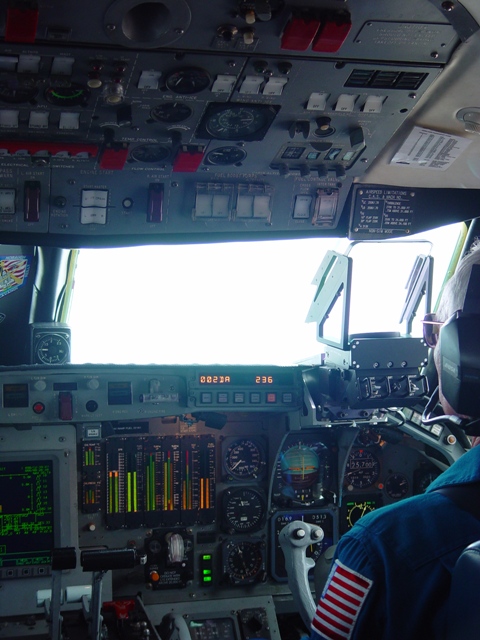
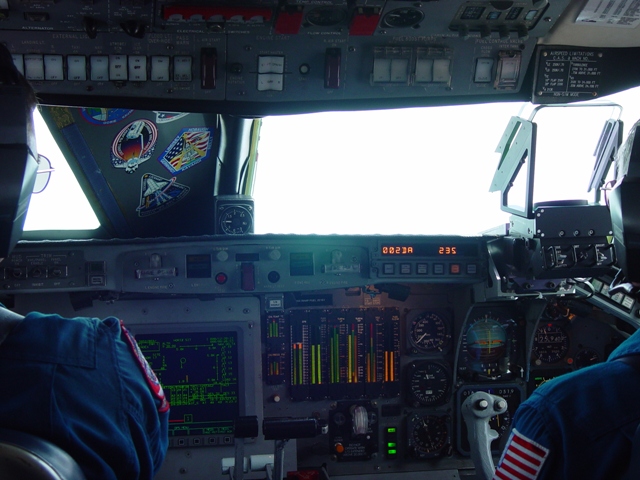
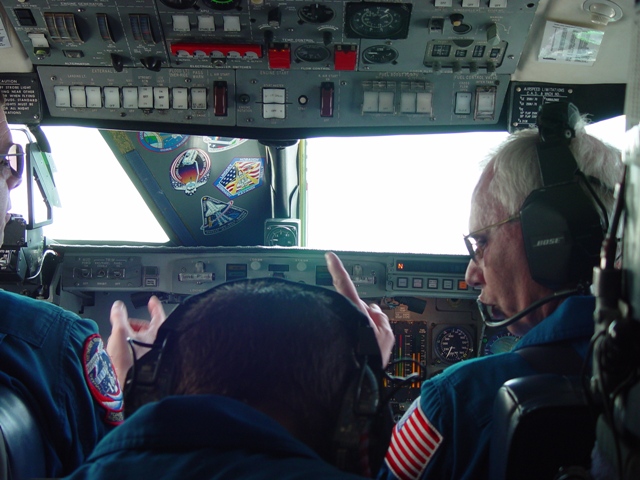
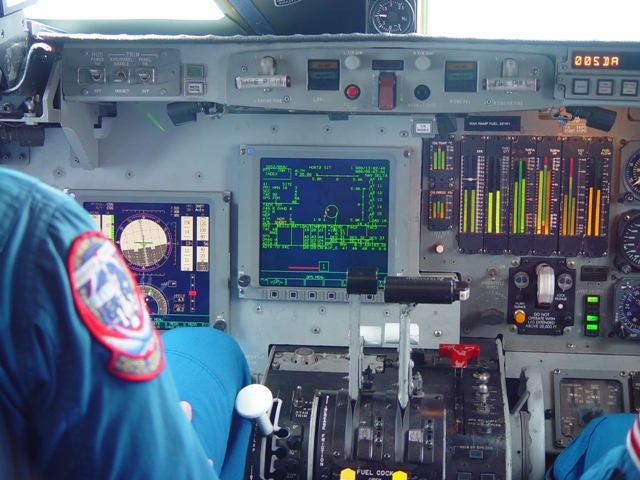
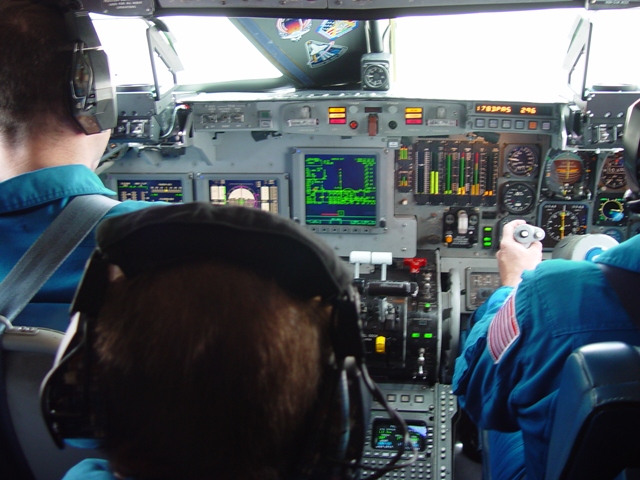
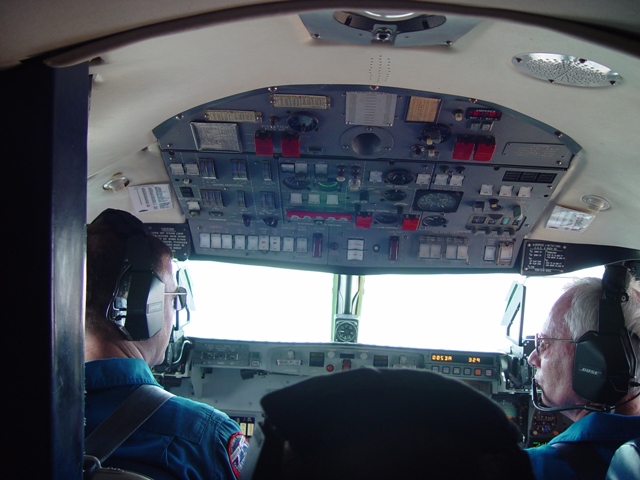
All that ended on a Tuesday morning in September, 2001. After that we were barred from the cockpit of any civilian airliner, a silly restriction that is still in affect to this day.  I mean, really, if you can’t trust an air traffic controller in the cockpit, why the heck would you trust your life to that same controller when they’re in the tower or working a radar scope? Fortunately, we still could “Fam” in military, general aviation, and other aircraft.  In my case, I was afforded the opportunity on more than one occasion to fly in the cockpit of the NASA Shuttle Training Aircraft (STA), a  highly modified Gulfstream II in which the left side of the cockpit is a replica of the instrumentation and flight controls used in the Space Shuttle.

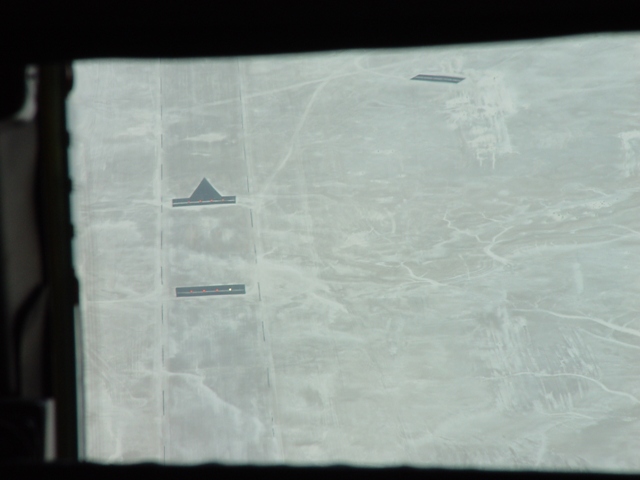
A normal mission profile called for the STA to launch out of El Paso International Airport and turn north on a heading for the White Sands Test Facility.  The Gulfstream is climbed to an altitude of 20,000 feet.  At approximately fifteen nautical miles from the Northrop Strip located at the White Sands Space Harbor, the main landing gear are lowered (the nose wheel gear strut remains retracted), the engine thrust reversers are engaged, the aircraft is nosed over into a steep descent, and the Shuttle pilot-in-training takes the controls.

Most jet aircraft approach for landing at a mild 3° descent angle and a leisurely 140 knots or so.  Not so the STA.  That baby drops out of the sky at a pulse-pounding 20° drop while doing 300 knots.  Only once the STA descends below 1,700 feet does the pilot initiate a flare (nose-up attitude) to decrease the glide angle and reduce the speed.  At 150 feet the nose wheel strut is lowered and, at a ridiculously low 20 feet above the runway, the instructor disengages the simulation mode, retakes control of the aircraft, and climbs the aircraft back up for another run.  A typical training mission calls for around ten approaches.

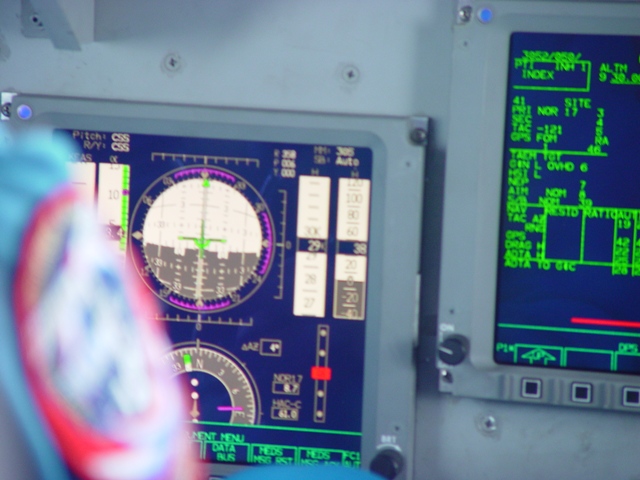
The following pictures were taken by yours truly on a flight profile I flew in May of 2005. Yes, I was standing up unrestrained.  Yes, I was actually looking over everybody’s shoulders.  Yes, that’s a real live astronaut in the left seat (Jim “Vegas” Kelly training for STS-114, just in case you were wondering).  Yes, it’s darned hard to maintain your balance when thrust is reapplied and the STA is nosed skyward in a hard, banking turn.  No, I did not lose my lunch.  Yes, I did think about it.  After just four or five such descents, you do start to get a bit queasy.

The covers you see being installed by Jim Kelly are used to simulate the view from within an actual Space Shuttle.  The left-side instrumentation and controls are similar to those on the Shuttle, while the right-side controls are more typical of a standard Gulfstream.  The pictures of the desert floor show the actual Shuttle landing strip (used for at least one Shuttle landing back in March, 1982) and the visual markings to the runway.

I hope you enjoy the show:


3 Comments

Filed under Author, Aviation Safety, Photography, Technology/New Stuff