Category Archives: Technology/New Stuff

Canon G1 X Review—Part 1


This begins a three-part review on Canon’s latest semiprofessional compact camera—the G1 X.  Today we’ll focus on how this camera was selected and highlight the performance of Canon’s latest image processor the DIGIC 5 and the effectiveness of this camera’s built-in image stabilization.

Canon G1 X with 15.1-60.4 (28-112mm in 35mm equivalency) f/2.8-5.8 lens.

If you’ve been following this blog since April 2, then you’ve been viewing the progression of our last cruise trip.  Last week we covered Bruges, Belgium, and this week I was going to end the series with our two-day stay in Brussels.  I’m going to postpone that series finale until next week, as I have some other information I would like to impart.

So, have you enjoyed the photographs over the past five weeks?  If so, then you can give at least partial credit to my latest photographic tool.  More on that in a moment.

I really enjoy DSLR photography.  For that I have a Canon EOS 5D with a 24-105mm f/4.0L Image-Stabilized lens and, a 70-300mm f/4-5.6 Image Stabilized telephoto lens, and a 430EX Speedlite external flash.  The 5D is a great camera capable of great images at even fairly high ISO settings.  Problem is that it’s a boat anchor around your neck.  When mated to my 24-105mm lens, the darned thing weighs in at a massive 3 pounds, 7.2 ounces (1,565 grams)!  And don’t even get me started on the conspicuousness of the size.  It’s like trying to hide a toaster oven.

So, for most international travel I like to take a couple of small travel zooms—my Panasonic DMC-ZS3 and DMC-ZS6—and leave the Rock of Gibraltar at home.  Those Panasonics are great little point-and-shoots with a fantastic zoom range (25-300mm in 35mm equivalency), but they have some serious limitations.  The ZS6 has limited controls for aperture and shutter speed, as well as the ability to provide some manual control.  The ZS3 won’t even do that much.  Because of their small sensor size (1/2.33”—6.08 x 4.56mm), neither is very good at anything above ISO 400, and the image actually starts to degrade well before even that.  Neither stores images in raw format.  Still, you can take award-winning photographs with them if you understand photography and how to get the most out what little control the ZS series offers.

But I still wanted more in the way of creative control, better high ISO performance, increased resolution, and the wider latitude that raw gives you in post-processing.  With this latest once-in-a-lifetime trip to Normandy coming up, I started doing my research for another camera system.

For travel photography I would need in order of importance:

1)      Wide angle capability for landscapes, preferably starting in at around 24mm (in 35mm equivalency).

2)      Good low-light capabilities for photographing interiors of monasteries, churches, cathedrals, fortresses, etc.  That means a fast lens at wide angles (f/2.0 or better would be ideal), good performance at higher ISO settings (at least ISO 800, preferably even higher), and exceptional image stabilization (at least 3-stops) for hand-held shots.

3)      Good low-light means a fairly large sensor.  There is simply no way around that using current technology.  This means I would have to balance the need for a large sensor against the desire to keep the camera/lens combination small and light.

4)      Moderate telephoto capability for zooming in on architectural details (I like at least 105mm).

Here’s what I didn’t need:

1)      Fast focusing.  In landscapes it’s all about the framing and light conditions.  Capturing action is toward the bottom of any travel photographer’s priority.

2)      High frames-per-second.  Again that’s for capturing sports action, playful puppies, rambunctious kitties, and annoyingly hyperactive children.

Here’s what I was willing to give up:

1)      Interchangeable lenses, if the range was close enough to my specifications (see above).  There’s nothing more bothersome than specks of dust on the sensor, and changing lenses in the field is an open invitation for these insidious invaders.  Plus, it’s heck trying to get cleaning solution for camera sensors past TSA—guns and knives seem to slip through with alarming regularity, but you’d better not have more than three ounces of anything wet, up to and including Granny’s Depends it would seem.

2)      Macro capability.  Nice to have for close-ups of flowers, but landscapes and architecture don’t normally require it.

3)      Wide aperture at mild zoom ranges.  That’s a hallmark of a portrait lens, as it defocuses the background and directs the viewer’s attention to the person being photographed.

Given this list, my search for a new travel camera began to look like a tall order.  Most bridge cameras have more zoom range than I would ever need, but their small sensor sizes (usually around 1/1.8”—7.176 x 5.319mm) meant I would once again be sacrificing ISO performance.  APS-C sensors are large enough for what I needed ISO-wise, but (save for one exception) we’re once again talking about going to a DSLR—a DSLR smaller than my full-frame (35mm) EOS 5D, but still a large, burdensome package.  I could go with a smaller ILC, but most use the smaller Micro Four Thirds system, some use an APS-C size, nearly all come with a kit lens that only zooms between 27 and 82.5mm (in 35mm equivalency), and I would be back to having an interchangeable lens dust magnet.

Life was suddenly looking like an endless series of compromises that I didn’t really care to make.  I was considering packages as small as the Canon G12 and Nikon P7100 and as large as the Sony NEX 5N and NEX 7.

Then came the April edition of my Popular Photography subscription.  Right there, on both the cover and on Page 77, was the Canon G1 X.  Specifications:

Huge 1.5-inch (18.7 x 14mm) 14.3 megapixel CMOS sensor.

4x 28-112mm zoom lens.

Great ISO performance through ISO 1,600, and perfectly acceptable all the way through ISO 6,400.  Only at ISO 12,800 did the G1 X reach unacceptable performance levels in Popular Photography’s testing, and even then it just barely scored outside the moderate range on noise (3.1 scored on a 3.0 cutoff).

Image Stabilization good for 3.5 stops even full-out zoom of 112mm.

Image quality and resolution both rated as Extremely High (vertical resolution 2,310 lines at ISO 100 and an incredible 2,220 lines even at ISO 1,600)

4.6 inches (117mm) wide; 3.1 inches (78mm) tall; 2.6 inches (68mm) deep (lens retracted); and weighing “only” 1 pound 4 ounces (566 grams) including battery, memory card, neck strap, and lens cap (I say “only” because that seemed high until I found out the G1 X is built like a tank on a stainless steel chassis).

Articulated 3-inch high-resolution (920,000-dot )screen.

Internal pop-up flash and a hot shoe for TTL (through the lens) flash metering and exposure control using Canon Speedlite flash units.
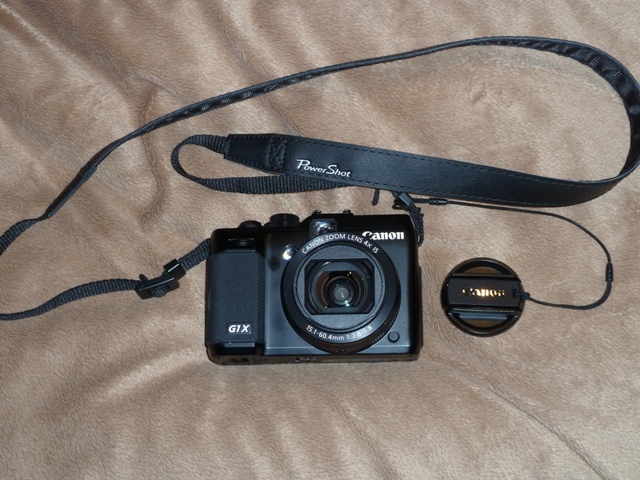
Canon G1 X with neck strap, lens cap, and lens cap retaining cord. Altogether with battery and memory card the entire package weighs in at 1 pound 4 ounces.

My search was over.  Yes, I was giving up a bit on the wide zoom side and lens aperture, but I was exceeding my specifications in nearly every other criteria.  On top of that, I was gaining the latest Canon image processor—the DIGIC 5.

My impressions on the DIGIC 5?  I’m personally stunned at the improvement over the EOS 5D’s DIGIC 2 on everything from automatic white balancing to contrast and color rendition.  Quite simply put, the DIGIC 5 in most cases makes raw photography and post-processing totally unnecessary.  Except for specialized instances requiring HDR (high-dynamic range) photography, extreme color shifts in lighting, isolated color spectrum subjects, or a few other situations, the DIGIC 5 will in my opinion consistently produce better pictures than I can with raw manipulation.  It’s simply that good.  You’ll be hard pressed to find an excuse to take anything but JPEGs with this camera.

The DIGIC 5 is also the secret behind the remarkably low-noise, high-resolution photographs taken at heretofore unusable high ISO settings.

The image stabilization is also astounding.  I was taking hand-held shots of cathedral interiors at shutter speeds as slow as 1/15th of a second.

Part 2 of this review will continue on Wednesday.  Until then, I would like to present the following hand-held pictures.  Move your cursor over the picture to find the shot details, such as ISO, shutter speed, aperture, etc.  None of these straight-from-the-camera JPEG photographs have been post-processed in any way other than to reduce the size for inclusion in this blog.  All colors, contrast, white balance, noise reduction and other factors result solely from the DIGIC 5 processor and the camera’s built-in image stabilization.

ISO 400, f/5, 1/15th second, 35.8mm (66mm in 35mm equivalency)

ISO 1000, f/2.8, 1/20th second, 15.1mm (28mm in 35mm equivalency)

ISO 500, f/2.8, 1/30th second, 15.1mm (28mm in 35mm equivalency)
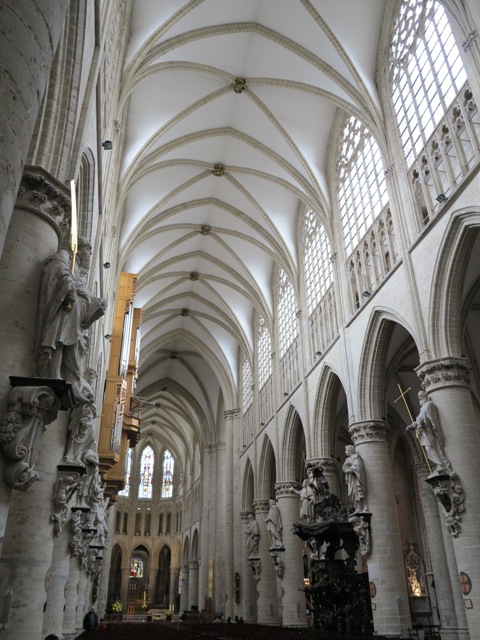
ISO 1000, f/2.8, 1/20th second, 15.1mm (28mm in 35mm equivalency)

ISO 1000, f/2.8, 1/20th second, 15.1mm (28mm in 35mm equivalency)

ISO 500, f/5.8, 1/80th second, 60.4mm (112mm in 35mm equivalency)

3 Comments

Filed under Photography, Technology/New Stuff

Shopping for a Camera—What NOT to DO!


Okay, I’m camera shopping.  Yes, I still love my Canon EOS 5D (although at coming up on seven years, it’s getting a bit long in the tooth).  I also still enjoy my two Panasonic travel zooms, the Lumix DMC-ZS3 and DMC-ZS6 (similar to the DMC-ZS7 discussed here).  Alas, there is just too much a gap to bridge in the capabilities between these two extremes.

The EOS 5D has almost everything you’d want in a camera—interchangeable lenses, raw capability, excellent high-ISO response with minimal noise, and great automatic functions yet full manual control for when you just want to take over for yourself.  But for most overseas travel?  It’s just too big, heavy, obtrusive, and conspicuous.

Panasonic used to make the best little travel zooms in the business . . . right up until they foolishly got caught up in The Great Megapixel War and degraded their image quality.  Until they did that, though, the ZS-series were great—shirt-pocket compactness, fantastic zoom range, fairly fast apertures, and adequate resolution.  Unfortunately, they wouldn’t take pictures in anything but JPEG and the high-ISO/low light capabilities left much to be desired.

That left me looking for something in between, which I’ve been doing for some time now.  Most of the current bridge cameras use the same small-sized sensors packed into the ZS-series and still wouldn’t give me raw capability.  Thus, all I would gain there is increased zoom range.  The newest mirrorless Interchangeable Lens Cameras (ILC) can get you raw and larger sensors.  But the largest sensor cameras in this category (Sony’s NEX series) start getting bulky again, and the kit lenses packaged with these cameras don’t have a very useful zoom range (for the NEX cameras the kit lens is in the vicinity of 27-82.5mm in 35mm equivalency) necessitating the need to haul around additional lenses.

Then the latest edition of Popular Photography arrived.  It appears that the camera that would most fill my particular gap is now available:  The Canon Powershot GX 1.  The sensor is huge for a compact camera—larger than Micro Four Thirds and just a tad smaller than APS-C, which is the standard size for the most popular consumer-grade DSLR cameras currently on the market.  The camera size is on the largish side, but not unmanageably so.  Image quality equals and in some cases even surpasses many of the more popular DSLRs on the market.  High-ISO noise levels are acceptably low all the way up to ISO 6400+ with minimal loss in resolution.

But what, you may ask, are my particular needs?  And why do I feel the G1 X addresses those needs?  Those are questions anyone in the market for a new camera should ask themselves.  But frequently they don’t, and that drives me insane.  I’ll get into why in a minute.

My particular photographic subjects trend toward travel, landscapes, and architecture (both exterior and interior).  Seldom do I photograph portraits, and I engage in macro photography even less.  That narrows considerably the features I need in any particular camera.  In this case, my “needs” tell me that I require a camera with a zoom range biased toward the wide side (preferably at least 24mm in 35mm equivalency).  I also need high-ISO/low light capabilities for nighttime shots and building interiors.  That means the camera should have a large sensor with low noise and a fast lens, preferably at least in the f2.8 range at the wide end.  But in travel photography mid-range telephoto zoom comes in handy as well.  Thus, the perfect lens for most of my needs would be in the 24mm-135mm range at f2.8-4.0.

So, what don’t I need?  I won’t normally need close focusing, as that is used in macro photography.  The G1 X just happens to have a terrible close-focusing distance.  I don’t need blazingly fast focusing or the ability to take large numbers of pictures per second as those are the hallmarks of a camera geared toward action photography and sports.  The G1 X only does 1.9 frames per second or, if burst mode is enabled, a one-second burst of six shots is possible—totally unacceptable for people with active kids and pets.  If I did more portraits, I’d probably want an aperture of at least f2.8 at between 85 and 105mm (in 35mm equivalency) so as to defocus the background behind the person, but with the G1 X I’ll be lucky to hit f5.0 in that range.

What will I get with the G1X and it’s fixed-lens?  A zoom range of 28mm on the wide side (less than I’d really like, but manageable) and 112mm on the telephoto end (again less than ideal, but not as important as the wide-angle aspect).  But I can always fall back on the 25mm-300mm lens of my ZS6 when needed.  I also get low-light images that exceed any other compact camera currently on the market, and often meet or exceed the capabilities of many DSLRs.  Look out, great cathedrals of Europe; here I come!  And then there’s the geek photographer’s capability (not really needed for most photographers in most situations, but nice to have)—the ability to capture images in raw for better post-processing control before conversion into JPEG format.

Now, back to my rant people who refuse to do their homework before making a camera purchase.  By now I’ve read probably two-dozen reviews on the G1 X ranging from expert to obvious novice.  One such review was on a well-known online vendor, and it was written by someone who owns an EOS 5D Mark II ( the successor to my old 5D).  The person was also looking for a camera to bridge the gap between his 5D and his desire for a point-and-shoot.  He wound up sending the camera back to that online vendor.  Why?  Because he wasn’t happy with the macro capabilities.  Well, DUH!  The specs are out there.  The specs plainly say that the minimum focusing distance ranges between 7.9 inches (20cm) and 2.3 feet (70cm).  Practically every reviewer has remarked that this camera really doesn’t have great or even adequate macro capability.  This was almost as stupid as the reviewer who sent back a Panasonic ZS-7 because the flash wasn’t strong enough to capture his kids indoors.  Hey, dude, it’s called a “Travel Zoom” for a reason.

But why should you care?  Because when people such as this don’t do their most basic research, when they box up and ship back the goods that didn’t meet their “expectations.,” they drive up the prices for you, me, and everyone else.  The company that sold this individual his G1 X isn’t going to take the hit for now having to resell an “open-box,” “used,” or “refurbished” item.  You and I are.  In this day and age of internet access and search engines, this kind of “try it out, see if it works, if not ship it back” attitude is, quite honestly, unacceptable.

So before you buy your next camera:  Analyze your needs.  Research online.  Read reviews.  Read more reviews.  Read even more reviews.  Narrow your search and study the specifications of the cameras on your short list.

And, whatever you do, don’t embarrass yourself by publicly posting a review that indicates you’re too stupid to be entrusted with either a credit card or a PayPal account.

Okay.  Rant over.  Now go out and find something to photograph.

3 Comments

Filed under Photography, Technology/New Stuff

How Contracting Government Gets People Killed—Part III


By now you should be getting a clear picture on what all this recent talk of privatization and contracting out of government services is really all about—lining the pockets of corporations with no tangible benefits or any real savings to the taxpayer.  And today you’ll find out that famous name who may be among the many victims of the Great AFSS Scam of 2005—the contracting out of this nation’s Automated Flight Service Stations.  (Again, the following was written in 2008 using data that was factual at that time; most of this stuff has only gotten worse since):

Automated Flight Service Stations
Duties and Responsibilities

Think of an AFSS as one-stop shopping for pilots preparing for flight.  A general aviation pilot will call these facilities to file a flight plan.  An Instrument Flight Rules (IFR) flight plan is conducted via instruments and utilizes positive Air Traffic Control (ATC) service from point of origination all the way to the destination airport.  A Visual Flight Rules (VFR) flight plan is filed when the pilot wants to fly on his or her own during good (visual) weather, but wants someone to know if they are overdue and what route they were taking in case of a mishap.  VFR flight plans are entirely voluntary, but considered a good safety practice for cross-country flights.  An overdue VFR pilot knows that Search and Rescue will be activated along the filed route of flight if they fail to check in at the destination by a specified time.

In addition to flight plans, AFSS briefers also advise pilots of weather information along their route of flight and at the airports they will be using, including instrument (low visibility/low ceiling) conditions, convective weather, and icing conditions.

Finally, there is the NOTAM system.  NOTices to AirMen directly affect the safe conduct of flights and are critical to flight planning.  Such information includes closed en route airspace along the intended route (military exercises, presidential movements, etc.), nonoperational navigation aids, ATC outages, runway or taxiway closures, and other information.

Airlines for the most part supply these services to their aircrews themselves.  Military aircraft access these services on military airfields through the military’s Base Operations facilities, but when operating from a civilian airfield revert to utilizing AFSS.  Most other pilots—including air ambulance flights, air taxis, and general aviation (private pilots)—file flight plans and get their briefings through AFSS.

As you can see, the information upon which the pilot relies must be complete, timely, and 100% accurate or it does the pilot no good—or worse, gets him killed.  For instance, whenever the President of the United States is away from the White House, there is a thirty-mile radius flight restriction placed around his location.  If, as an example, he is at a ranch in Crawford, Texas, or giving a speech in Las Cruces, New Mexico, the FAA issues a NOTAM advising pilots to remain at least thirty miles away from his precise location at all times.  Any aircraft violating this closed airspace is intercepted by fighters, escorted to a nearby airfield, ordered to land, and the pilot taken into custody.  Pilots then face suspension of their license and other possible penalties.

That is if everything goes well.  If the pilot does not see the interceptor, or for some reason acts suspiciously or continues in a direction toward the president’s location (which one would expect if the pilot is not aware of the NOTAM), they face combat engagement, destruction of the aircraft, and death.  The stakes are high.

Lockheed Martin AFSS briefers have in the past failed to advise VFR pilots of just such Presidential Movement NOTAMs.  Frequently.  So far nobody’s aircraft has been fired upon.  Nobody has died.  Yet.  Fortunately for such pilots, and unfortunately for Lockheed Martin, such pilot briefings are recorded.  These recordings have saved victimized pilots from losing their license and worse.  These recordings have not however prevented Lockheed Martin from continuing to collect their $3 million quarterly bonuses.

A Complete Disintegration of Service

As Lockheed Martin’s tentacles continued to entwine and eventually strangle the nation’s AFSS infrastructure, pilot services started deteriorating to totally unacceptable, dangerously unsafe levels.  Callers routinely reported waits of forty minutes and more.  When pilots did get through many of the flight plans they filed with AFSS never showed up in the NAS computers even after repeated callbacks by both exasperated pilots and frustrated Air Traffic Controllers.  I have lost count of the number of times I have had to disengage myself from separating aircraft or performing other safety-related duties and divert my attention to manually entering such flight plans into the system myself.  So, how bad has it gotten?

Let us take a look at the number of AFSS ‘operations’ for the years 2002 through 2006.  During those years operations steadily declined: 2002-27,714,000, 2003-26,633,000, 2004-25,922,000, 2005-22,519,000, 2006-19,744,000.  As you can see, since October 2005 when Lockheed Martin took over AFSS functions, the number of pilots calling in started dropping more rapidly.  Indeed, from 2005 (the last partial year in which the FAA handled AFSS functions) to 2006 (the first full year Lockheed Martin controlled AFSS) there were approximately 2,775,000 fewer pilot calls.  This is the single biggest drop by far for the years listed.

But take a look at the number of AFSS operations in 2007.  That year the number of pilots calling in dropped to 7,715,000, an astounding 61% decline in just one year!  What does that mean in real terms?  It means that pilots gave up trying to get through to AFSS twelve million times in 2007.  Millions of VFR flight plans didn’t get filed.  Millions of pilots got their en route weather information from non-aviation, non-FAA approved sources.  Millions of pilots conducted flights researching on their own for NOTAMS directly affecting their safety.  This reduction in operations partially explains why Lockheed Martin was finally approaching the level of service pilots enjoyed when the FAA handled this function—over half the customers were chased away.

And in case you think things couldn’t get any worse, the figures for 2008 showed yet another 31% drop.  That year AFSS operations totaled 5,334,000.  But wait, that number is actually worse than it appears.  You’ll recall that the Agency was ordered by Congress to keep its three Alaskan AFSS facilities.  Ironically this exemption was a provision placed in the budget by pro-privatization Republican Congressman Don Young.  Congressman Young apparently doesn’t mind risking other states’ citizens, but when it comes to his constituents . . . well, apparently only the best will do, and the best did not include Lockheed Martin.  But I digress.  The point is, if you subtract from the total AFSS operations those conducted by the FAA’s three Alaskan stations, Lockheed Martin’s customer base is down to an embarrassingly low 4,778,000.

As complaints rose and Congress demanded action from Marion Blakey, who in turn began applying pressure to Lockheed Martin by withholding that one quarter’s worth of bonus money, Lockheed Martin set up a system to automatically reroute calls from busy AFSS facilities to others in different areas.  The problem with this ‘solution’ is that it creates another even more dangerous problem.  You will recall that one of the contract stipulations is that pilots will get briefings from personnel familiar with the area in which they will be flying.  But that requirement went out the window with this call rerouting scheme.  Now, a pilot in Tucson, Arizona, who calls the Prescott AFSS may find that the briefer to whom he is entrusting his life and the lives of his passengers is operating out of the AFSS in Lansing, Michigan—a briefer who has never even seen the desert Southwest, let alone shown any actual familiarity with the local weather, military restricted areas, terrain, and other safety critical information.

Now go back to that drop in customer contacts.  When one considers that efficiency is in large part measured by the cost per operation, this reduction in customers means that the taxpayer is paying several times more per AFSS operation since contract implementation.  A conservative estimate would be that the cost per operation is over triple and probably close to quadruple what it was pre-privatization.

One would think that Lockheed Martin would take advantage of this historic, unprecedented drop in AFSS operations to finally get its house in order.  Corporate profits dictate otherwise.  On October 15, 2008, Lockheed Martin announced the surprise closing of an additional five AFSS facilities and the termination of 158 badly needed AFSS specialists.  The facilities on the chopping block were Albuquerque, New Mexico; Oakland and San Diego in California; Denver, Colorado; and Macon, Georgia.  Pilots calling these facilities would in the future find themselves talking to specialists in Asburn, Viginia; Prescott, Arizona; and Fort Worth, Texas.  Those pilots had better hope that, unlike the previous call rerouting scheme, they wind up talking to a specialist who is relocated from one of the closed facilities, and who is thus familiar with their flight route.  Their lives will depend on it.

So… Who Could Possibly Still Defend This Mess?
The Person Who Initially Proposed it

Robert Poole of the Reason Foundation likes to brag that he invented the term ‘privatization’ in regard to contracting out public services.  He acted as an adviser on privatization and transportation to the George W. Bush Administration and applauded Marion Blakey’s outsourcing of AFSS.  Now that the U.S. taxpayer is saddled with paying Lockheed Martin to service less than a quarter of the customers the Agency originally handed to them in 2005, what does Poole have to say for himself and his now discredited ideas on privatizing ATC services?  In his June 2008 Air Traffic Control Reform Newsletter #54 he stated:

“Alas, things did not go smoothly during the consolidation from 58 facilities to just 20. Calls did not always get answered promptly, some of the new briefers did not get up to speed quickly, and many private pilots complained bitterly and at some length. As an advocate for his members, (Phil) Boyer (President, Aircraft Owners and Pilots Association) highlighted the problems and urged the FAA to take action. But to his credit, he did not back down or change his mind that outsourcing was the best way to reduce costs, modernize the operation, and keep the program viable.

“Fortunately, Lockheed Martin has taken action to add surge capacity to handle peak periods better, added staff and workstations, and brought back some retirees, on a part-time basis, to beef up training. In his June 2008 editorial in AOPA Pilot, Boyer reports that complaints at Pilot Town Meetings are way down, and 80% are satisfied or very satisfied with the service they are now getting. The FAA is reporting on the level of service every 90 days.

“Thus, what started out looking like it might have been a fiasco turned out to be just transition problems. Assuming today’s high levels of user satisfaction are maintained, I can’t see any political case for attempting to overturn the LM contract.”

“… transition problems….”  Nearly 80% of AFSS customers chased away by total ineptitude, yet Poole still holds up the AFSS example as a privatization success.  Amazingly recalcitrant for one so wrong so often, as we shall see later.  One supposes that of the perhaps hundreds of people who’ve died as a direct result of having given up on such poor AFSS service, none were acquaintances or relatives of Robert Poole.

And Real People Do Die
as a Direct Result

How many pilots and their passengers have died as a direct result of this degradation in service?  One can only speculate.  For instance, was aviation pioneer and world record-setter Steve Fossett one of the twelve million who just gave up calling Lockheed Martin in 2007?  Did he take off using non-aviation weather information . . . information that would not have included turbulence and wind shear information in the mountainous area in which his Bellanca was eventually found?  Did he even know, as a deputy sheriff reported that day, that isolated thunderstorms with their associated microbursts and downdrafts were popping up over and around the mountainous terrain in which the wreckage of his aircraft was eventually discovered?  If not for the long telephone waits, might he have otherwise filed a VFR flight plan with his intended route of flight, thus aiding search and rescue personnel in locating the wreckage in a matter of hours as opposed to thirteen months?

We’ll never know for certain if this is the case with Steve Fossett, but we can be certain that other, less well-known victims have indeed been killed because they gave up trying to get through to a Lockheed Martin AFSS briefer.

There are other things of which we can be certain:  AIA member Lockheed Martin will continue collecting their quarterly $3-million dollar bonuses for contractual requirements they’ve never met.  The FAA managers who make sure those bonuses continue rolling out the door despite obvious breach of contract will one day be rewarded with lucrative, post-government jobs by an AIA member (perhaps even Lockheed Martin).  And finally, we can be certain that Marion Blakey will continue in her capacity as President and CEO of AIA for far more than she earned as Administrator of the Federal Aviation Administration.

Most of you reading this book will shrug off the consequences of the privatization of AFSS because you only fly commercially.  You would do well to pay heed.  AFSS was not the only privatization target of the Bush Administration and their agent of implementation, Marion Blakey.  Many are firmly convinced that the ultimate goal was to sell off to corporations the entire triad of Air Traffic Control—Flight Service Stations, Terminal Control Facilities (Towers and TRACONs), and perhaps even the Air Route Traffic Control Centers (ARTCC).  But before she could accomplish this sell-off, Ms. Blakey, Secretaries of Transportation Mary Peters and Norm Minetta before her, Congressman John Mica, and other conspirators would have to destroy both the union representing the nation’s ATC workforce and the very system itself.

Fortunately for the flying public, they failed despite their best, illegal efforts to do so.

In this segment you saw how taxpayers wound up actually paying more to Lockheed Martin than the FAA spent on the same function . . . and you’re paying that larger amount to handle only about 20% of the calls because Lockheed Martin chased away upwards of 80% of their customer traffic with incredibly bad service.  And what ever happened to those 80% of pilots who gave up listening to busy signals, getting put on hold, having their radio calls go unanswered, or their flight plans just disappear into thin air?  As you have seen, some of them died as a direct result of this scam.

If you fly and you value your life, tell your Congressman and Senators that you don’t want the same thing happening to the rest of this nation’s air traffic control infrastructure.

copyright © 2011 R. Doug Wicker

No portions of this article are to be used, quoted, copied, or retransmitted without the permission of the author.

Share on Facebook

2 Comments

Filed under Aviation Safety, Technology/New Stuff