Category Archives: Firearms

Revolver Week — Ladies’ Day with a S&W Model 60-7 “Lady Smith”


Smith & Wesson Model 60-7 “Lady Smith

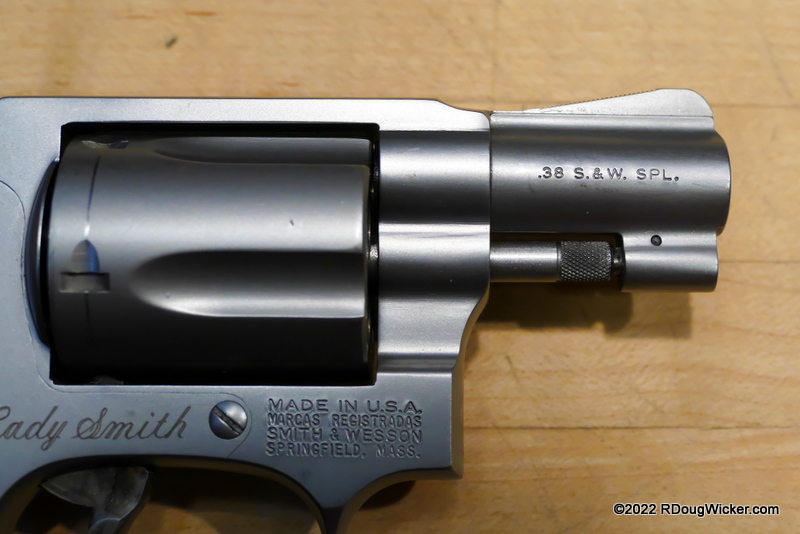
Okay, ladies, admit it. The miniscule revolver pictured above is just so darned cute! Today’s Revolver Week article is on a gun that Smith and Wesson specifically marketed toward women, the Lady Smith variant of a S&W Model 60, change 7. And there’s quite a history behind the Model 60, as it began life as a Model 36 “Chief’s Special” which, as you may have guessed by that name, was designed in 1950 as a small-framed concealable revolver suitable for plain clothes police duty.

S&W Model 36 “Chief’s Special” (image from S&W online catalog)

The first thing you’ll notice in observing the differences between the Model 36 shown above and Model 60 is that the former is blued and the latter is made of stainless. The Model 60 presented today was probably made in late 1994, which would place it near the middle-to-late range of 60-7 production (1990 to 1996). These were the last Model 60 revolvers made before Smith and Wesson changed the line to the J-Frame magnums, which were able to take the much hotter .357 Magnum load in addition to the milder .38 S&W Special (hereafter the .38 Spl).

S&W Model 60-7 “Lady Smith

Once again, when dating any Smith & Wesson revolver, the serial number is the key. This example falls in the BRS range:
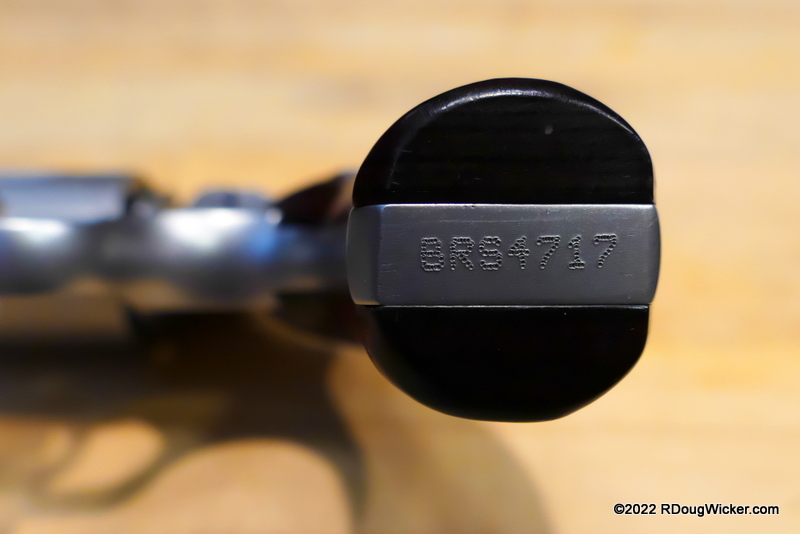
S&W revolver serial numbers are on the butt of the weapon

Change 7 is considered by many as the apex of the Model 60 design, so there is a demand for them. There are a couple of reasons for that. First, change 7 brought about a different heat treatment that strengthened the gun. Next, it was the last of the Model 60 revolvers to be chambered solely for .38 Spl. Why is that a factor? Because, let’s face it, does a .357 Magnum load in a compact, light, small-gripped, five-shot revolver really make sense to anyone? It doesn’t to me, especially when you’re throwing lead from a barrel that measures under two inches in length. So, why bother?

The five-shot S&W Model 60 sporting “Lady Smith” rosewood grips

Smith & Wesson Model 60-7 “Lady Smith“:

  • Length: 6.38 inches/162 mm
  • Barrel length: 1⅞ inches/47mm
  • Height: 4.41 inches/112 mm
  • Width (at cylinder): 1.30 inches/33 mm
  • Width (at grips): 1.22 inches/31 mm
  • Width (frame): .55 inches/14 mm
  • Weight (unloaded): 19.92 ounces/565 grams
  • Caliber: .38 S&W Special
  • Capacity: 5
  • Trigger pull (single-action, average of five pulls): 2 lbs. 10.4 ozs./1.2 kilograms
  • Trigger pull (double-action, estimated): 11 to 12 pounds/5 to 5.4 kg
Five-round cylinder of the S&W Model 60

As you can see from the specifications above, handgun is small, light, and adequate. It’s easily concealable in either a holster or a purse, although I tend to steer people away from off-body carry. Purses can to snatched; guns in retention holster, not so much. The grip is a tad small for the .38 Spl. My pinky has minimal purchase when I hold the Model 60, and my fingers wrap completely around the gripto meet my palm just below the thumb. But Ursula’s fi9ngers seemed better positioned when I asked her to hold the “Lady Smith.” I’ve yet to fire this example, but I doubt either I or Ursula would have trouble controlling it. But if it were a later .357 Magnum variant loaded for bear… well, that would probably be pretty painful
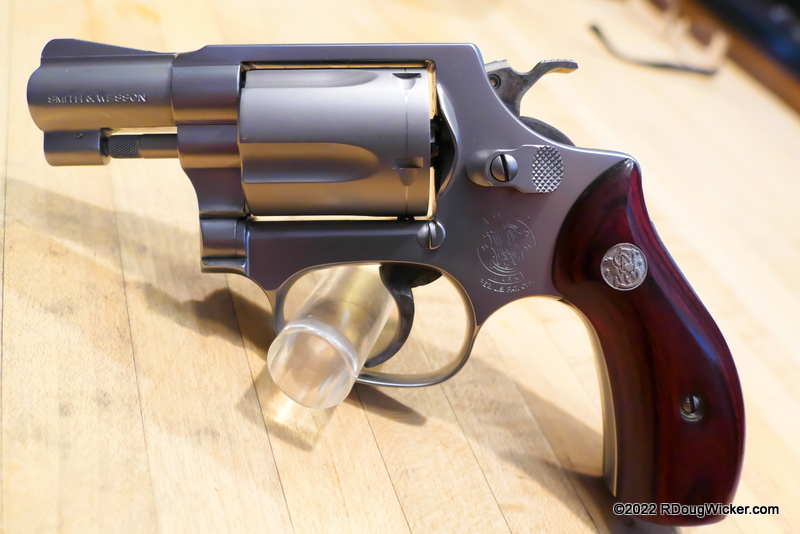
S&W Model 60-7

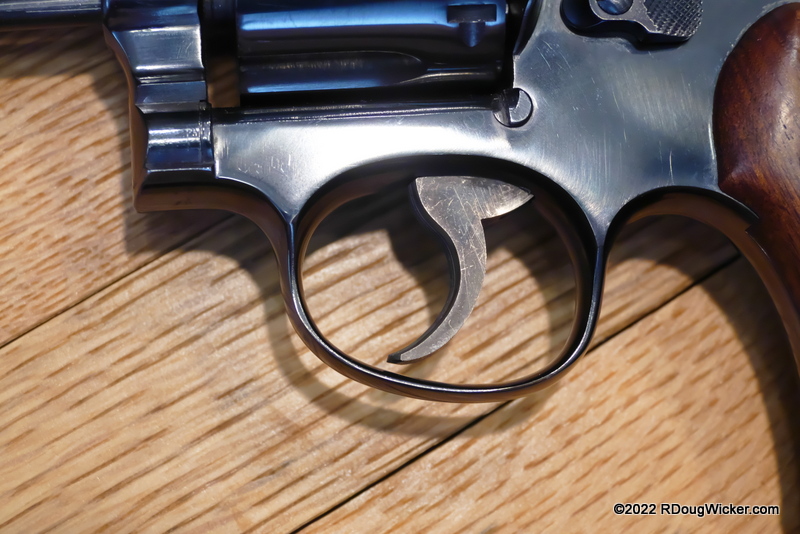
And then there’s that superb Smith & Wesson double-action/single-action trigger which I described in Monday’s article on the S&W Model 10-5. The trigger on this smaller J-Frame is not much different. Indeed, the single-action pull is even lighter than what I measured on the larger K-Frame. But in double-action there is a slight difference. Whereas the Model 10 had no take-up upon initiating the pull, the Model 60 has an odd millimeter or so of travel followed by a barely audible “click” before the trigger engages. After that, the double-action pulls are nearly identical between the two revolvers — smooth all the way to hammer trip. This clicking may or may not be related to the hammer spring, as the Model 10 uses a leaf spring, and the Model 60 uses a more modern sprung strut:

Model 60 hammer strut
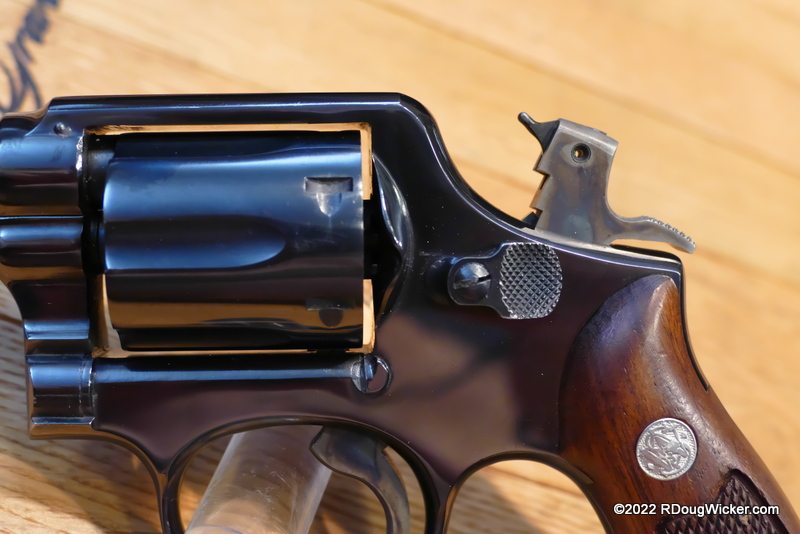
With the hammer cocked, this Model 60 is in single-action mode

By the way, ever wonder about the actual difference between a “medium” K-Frame and a “small” J-Frame? You’ll recall on Monday I wrote about a K-Frame S&W Model 10-5 in .38 Spl. Today we’re looking at a J-Frame S&W Model 60-7 in the same caliber. So, let us compare. Both being .38 Spl, it made since for this comparison to line up the back of the cylinders in the below image. Mentally subtract the barrel and disregard the grips and you’ll note that there really isn’t a whole lot of dimensional difference between the 6-round Model 10 and the 5-round Model 60. The difference in cylinder widths is noticeable, as one would expect — 1.46 inches/37 mm (K-Frame) vs 1.30 inches/33 mm (J-Frame). But the real difference shows up in the height of the weapons, which is most impacted by the grips. It’s on that measurement that the J-Frame wins the concealability race by .71 inches/18 mm.

J-Frame Model 60 above a K-Frame Model 10

As I noted on Monday’s article, to check the Model and Change numbers on a Smith and Wesson revolver, just open the crane and check. Below you can see that this is a Model 60-7:
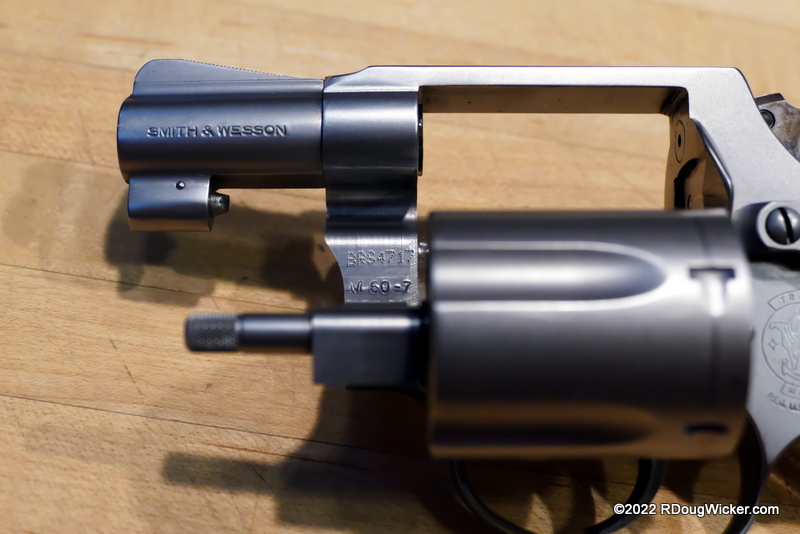
M 60-7; short for Model 60 Change 7

In the above photo of the Model 36 “Chief’s Special” you’ll see Smith and Wesson’s tradition checkered wood grips. The “Lady Smith” on the other hand sports smooth rosewoods in a deep, rich, reddish hue:

The stylish rosewood grips of the “Lady Smith” Model 60 variant

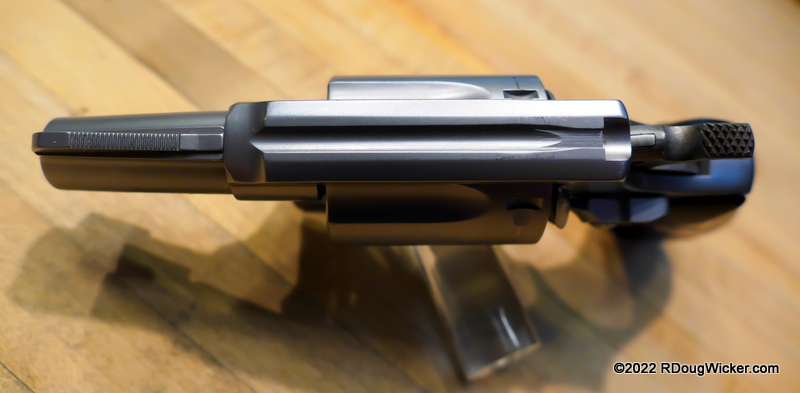
Gun sights are as you would expect for a weapon made for short range defense — fixed front paired with a channeled rear “sight” running along the top strap:
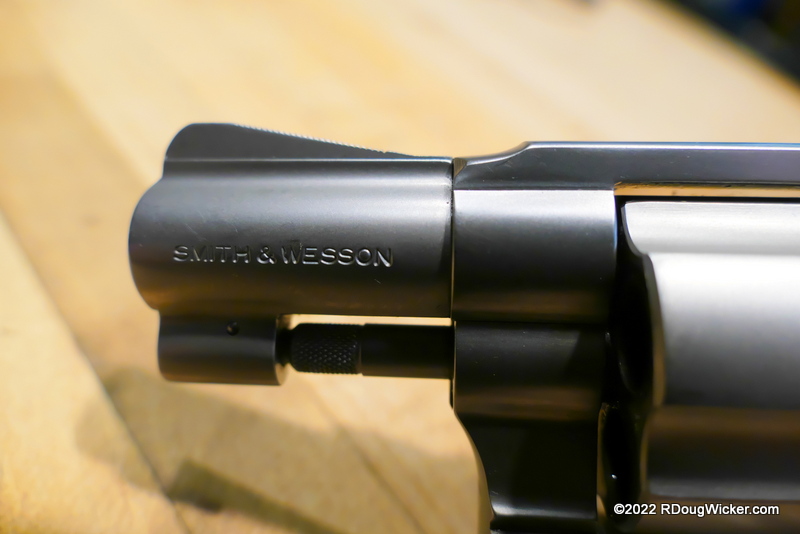
Model 60 fixed front sight
Groover rear “sight” of the Model 60

Put the two together and this is what you’ll see, which is probably adequate for ranges out to about ten to fifteen yards or so:

Model 60 rear sight view, but…
… when aiming a gun, focus on the front sight and place it on target

The “Lady Smith” variant of the Model 60 first appeared in the 60-6 in 1989. Indeed, all -6 revolvers where so marketed. It was only with the Model 60-7 that both “Chief’s Special” and “Lady Smith” variants were marketed under the same change number umbrella.

“Lady Smith” marketing stamp on this Model 60-7

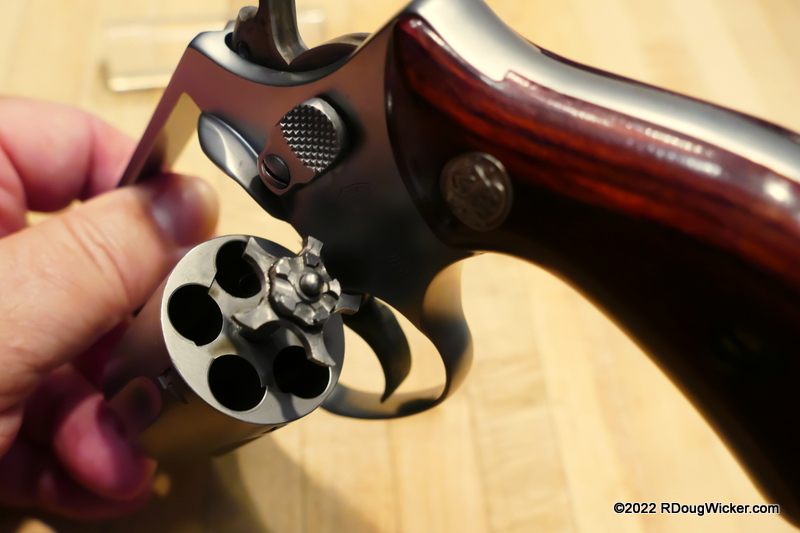
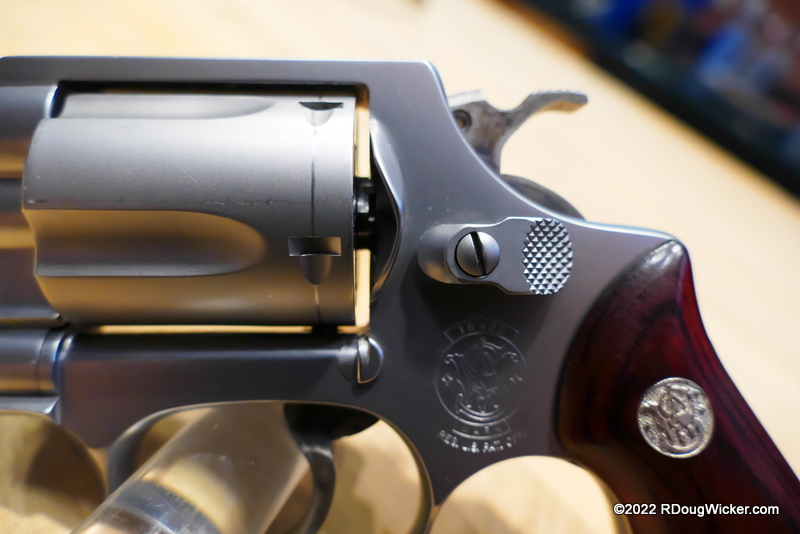
I hope you enjoyed Ladies’ Day here on Revolver Weeks. Friday I’m going to present a fake. A fraud. An outright rip-off. But it’s a rip-off with a lot of history behind it, made by some of the most ingenious gunsmiths on the planet. Gunsmiths who operate furnaces in their backyards, manufacturing their own parts on a scale you simply will not believe. Until then, here’s today’s gallery of additional Model 60-7 “Lady Smith” images:
Comments Off on Revolver Week — Ladies’ Day with a S&W Model 60-7 “Lady Smith”

Filed under Firearms, R. Doug Wicker

Revolver Week — Military Monday with a S&W Model 10-5


Smith & Wesson Model 10-5

Next week we return to travel and travel photograph, but this is Revolver Week. And today we begin Revolver Week with a Smith & Wesson Model 10, change 5. Or, more simply, a Model 10-5. This particular example dates back to 1966-1967. I can say that because of the serial number (see below). The “C” range of serial numbers stretched from 1948 until they ran out in 1967. The range for 1966-1967 are serial numbers C810,533 through C999,999. As such, I guesstimate this one at probably around the late-first to mid-second quarter of 1967. But that’s a pure shot in the dark.

So, why am I calling this “Military Monday?” Because before Smith & Wesson changed the name to Model 10 in 1957, this line of revolvers was called Military and Police model, or M&P for short. And, yes, both the military and numerous police departments in both the U.S. and around the world used the M&P revolver back in its heyday.

S&W Model 10-5, formerly the M&P model

This line of revolvers has a long, long history, beginning way back with its introduction as the Smith & Wesson .38 Hand Ejector Model of 1899. Since that time it has gone under several names, including the S&W Victory Model used during World War II and exported to various allied powers such as Australia, Canada, New Zealand, and the United Kingdom. But I digress. Today’s topic is specifically on the Model 10, and this example is the fifth change of that model.

S&W Model 10-5, hammer cocked

If the profile of this gun appears vaguely familiar to my readers, it’s because the Model 10 is a K-Frame (medium frame) revolver. And, yes, I’ve done a previous article on a rare pre-war K-Framed S&W K-22 Outdoorsman. Both have the classic tapered “pencil” barrel, but the K-22 is chambered in .22 LR, while the Model 10 and its predecessor the Hand Ejector Model of 1899 were made to handle the .38 S&W Special cartridge (hereafter referred to as “.38 Spl”).

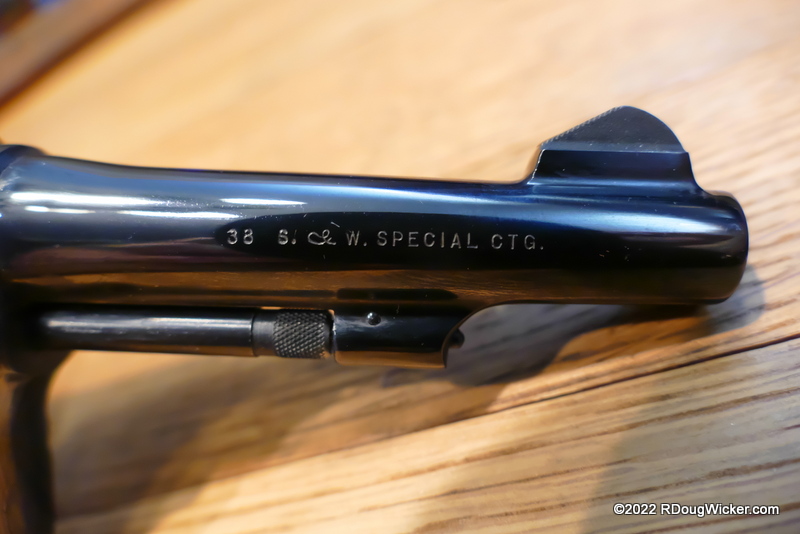
.38 S&W SPECIAL CTG. (CTG. = Cartridge)

The bluing on this particular example is exquisite. Perhaps too exquisite. While the stamps and roll marks are incredibly sharp, my go-to guy Paul Lee, owner of my favorite local gun store El Paso Gun Exchange, looked over the weapon and thought he detected minute evidence of blued-over pitting on the frame backstrap. As I trust Paul, I’ll just go ahead and declare this one a probably reblued weapon. But you sure could fool me when you see this kind of clarity:

S&W trade mark
Smith & Wesson production stamp

That crispness extends even to the assembly numbers hidden beneath the left grip and inside the crane:

Assembly number stamped on the frame butt
Assembly number on the crane, matched to the number on the frame butt

While we’re looking at the stamps inside the crane, here is how to tell both the model and change number on a Smith & Wesson revolver:

MOD. 10-5; Model 10, change 5

The image below shows the frame backstrap, which Paul thought might indicate that the finish was not original:

Paul’s eyesight is a lot better than mine, apparently

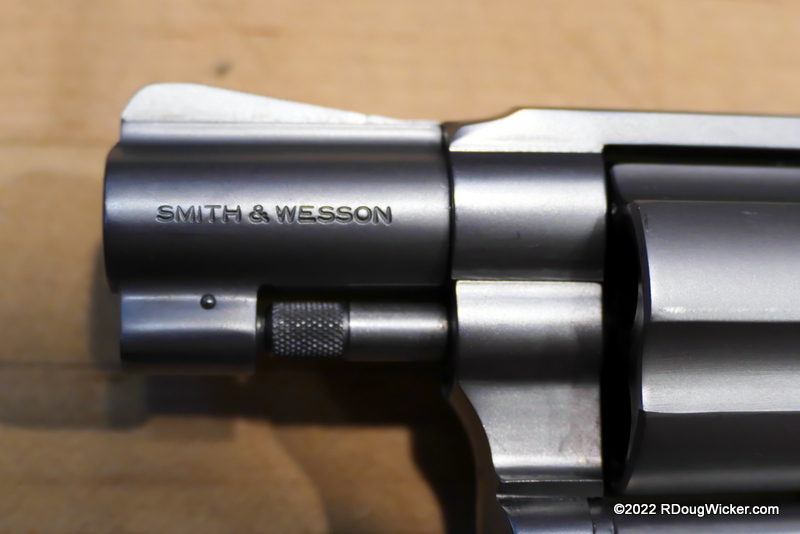
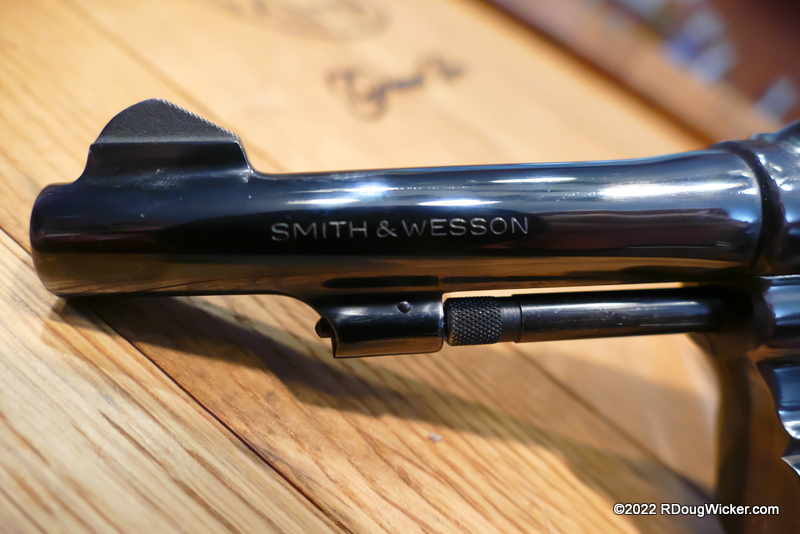
So, how do you tell if a Smith & Wesson is a Smith & Wesson? Silly question:

SMITH & WESSON roll mark on a 4-inch tapered “pencil” barrel

The M&P and Model 10 were basic, dependable, well-built revolvers. As they were designed for military and police budgets, there aren’t a lot of frills here. That extends to the very basic sights — a fixed blade ramped front sight paired with a rear “sight” that is nothing more than the groove running alone the top strap. Not that there’s anything wrong with this, as this type sighting system has been a fixture of revolvers dating well back into the 19th century.

Rear “groove” sight running along the top strap
Front ramped “blade” sight

Now let’s discuss the particulars of the Smith & Wesson Model 10 with a four-inch tapered “pencil” barrel. The trigger pull in double-action is estimated, as it exceeded the limitations on my digital guage. Single-action measurement is an average of five pulls.

  • Length: 9.13 inches/232 mm
  • Barrel length (actual): 3.94 inches/100 mm
  • Height: 5.12 inches/130 mm
  • Width (cylinder): 1.46 inches/37 mm
  • Weight: 30.64 ounces/869 grams
  • Capacity: 6 rounds
  • Caliber: .38 S&W Special
  • Trigger pull (single-action): 2 lbs. 12.1 oz./1.25 kg
  • Trigger pull (double-action): approximately 11 to 12 lbs./5 to 5.4 kg
S&W Model 10-5 cylinder

The firing pin on the Model 10 is fixed directly onto the hammer. But you needn’t worry. Although this model lacks a transfer bar, there is an internal hammer block that keeps the firing pin safely away from the cartridge primer unless the trigger is pulled. Unlike the old West-style single-actions, it is safe to carry this gun with all six chambers loaded. When I released the trigger, the top of the hammer receded a full ⅜ of an inch/9.5 mm.

Firing pin on the hammer

Let’s discuss Smith & Wesson’s marvelous trigger, a feature I love with every older S&W revolver I’ve ever handled. It is, quite simply, superb in both double-action and single-action. Double-action is as you would expect — long and a bit weighty, but easily controllable through the pull. There is a slightly audible click just prior to halfway through the pull, but there is zero grittiness or hesitancy all the way to the trip of the hammer.

S&W Model 10-5 with hammer cocked

But single-action is where these old Smiths really shine. There is absolutely no take-up on the single-action pull, and the trigger weight is an almost uncomfortably light 2 pounds, 12.1 ounces/1.25 kilograms. I say “almost” because I’ve trained for years with DA/SA weapons, mostly older hammer-equipped semiautomatics, so I’m comfortable firing pretty much any weapon is either double-action or single-action. Those who grew up firing Glock-style, striker-fired weapons will probably be taken aback by the lightness of this trigger when the hammer is cocked back. On Wednesday I’ll be taking a look at a S&W Model 60-7, but I’ll tell you right now that trigger is even a couple of ounces lighter in single-action, so this superb trigger is not an anomaly with Smith & Wesson.

S&W Model 10-5, grips removed, cylinder open, leaf hammer spring exposed

Wednesday’s revolver is one for the ladies, another Smith & Wesson. On that article I will present to you a S&W Model 60-7 “Lady Smith” also chambered in .38 Spl, but in a more compact J-Frame. Until then, I’ll leave you with this remaining gallery of Model 10 photos:

Comments Off on Revolver Week — Military Monday with a S&W Model 10-5

Filed under Firearms, R. Doug Wicker

Fun Firearms Friday — First Look: Ruger® AR-556® MPR


We’re finishing up “M” Week at the blog. Monday was Mosin. Wednesday we ran with Marlin. Today’s “M” is for Ruger’s MPR version of their AR-556.

I finally gave in to the AR-style rifle bug. But give in I did, after a lot of research. I had no desire to ever travel this road again, and I didn’t want to make a mistake, so I studied for months. Along the way I discovered a lot of information that directed me towards today’s subject — the Ruger AR-556 MPR (Multi-Purpose Rifle).

What were the other contenders, and how did I finally arrive at the AR-556 MPR? Let’s explore that for a moment, bearing in mind that my choices won’t necessarily align with your choices.

I’ll start with a brief look at the original AR-15 designed around the .223 Remington round. The .223 Remington was developed for the commercial varmint rifle market back in 1957, and by 1963 the first rifles chambered for this round became available. Eugene Stoner got involved when Remington invited him to scale down his existing ArmaLite AR-10 to handle the .223. The result was the ArmaLite AR-15, which like the AR-10 uses a unique direct gas impingement design (okay, not technically correct, but “direct impingement” is the popular name for it) that directed gas directly into the bolt carrier to cycle the weapon. Mr. Stoner set the barrel length at 20 inches/50.8 cm to make full use of the propellant in the .223 Remington, as barrels shorter than that length resulted in incomplete ignition of the propellant before the bullet exited the muzzle. That 20 inches also allowed for an optimal “rifle length” gas system, which would reduce recoil, thus lessening the stress on the bolt and buffer, and introduce less gas-fouling into the bolt carrier. Keep that in mind, as shorter barrels result in a shorter gas system, more recoil, faster bolt speeds causing more stress, and hotter gases getting introduced into the bolt carrier.

About this time the U.S. Air Force were looking for an alternative to their M1 and M2 carbines, and the Army were considering something easier to handle in full-automatic than their M14. This led Colt to purchase the rights for Mr. Stoner’s AR-15 from ArmaLite (contrary to myth the “AR” in “AR-15” stands for ” ArmaLite Rifle, not “Assault Rifle”). Colt then further developed the now “Colt” AR-15 into the M-16 chambered for the M193 cartridge. The M193 (not to be confused with the later similar NATO 5.56 mm round developed by FN in the 1970s) is basically a 55-grain/3.56 gram version of the .223 Remington. After some trial and error, Colt settled on 6-groove rifling with a 1:12/ 1:30.48 cm right-hand twist optimized for the lightweight 55-grain round.

Yeah . . . just  try to find a rifle-length gas system on an AR-style rifle today. There are some out there, but you’ll pay for it. The rage today is to go tacti-cool and get the barrel length down to the legal non-NFA minimum of 16 inches/40.6 cm barrel. That’s because the military’s current M4 version has a ridiculously short 14.5-inch/36.8 cm barrel and, hey, everybody wants that military look regardless of how the rifle performs in most civilian applications. (Again, don’t take offense; I’m describing my preferences here, not necessarily your preferences.)

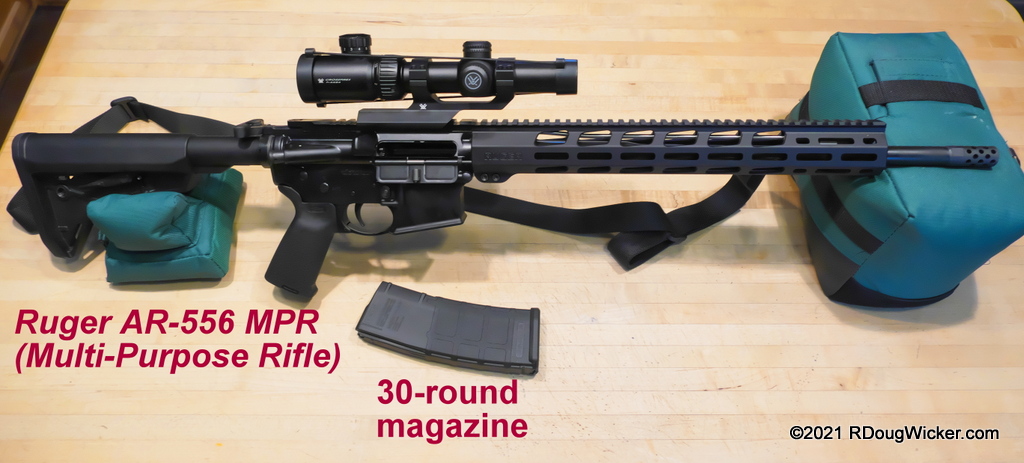
Ruger AR-556 MPR comes in one 30-round magazine

But remember what you give up for the modern Battle-of-Fallujah look — that rifle-length gas system goes by the wayside. That gets you incomplete burning of propellant; which in turn results in a reduction in muzzle velocity and energy; increased muzzle flash from the still-burning propellant blasting out the muzzle; increased bolt speed with the additional wear-and-tear that entails; and more fouling in the receiver from hotter, unburnt gases. Sorry, but I’m just not seeing any real advantages here for civilian applications. It’s not as if I’ll be using a shortened AR-style rifle with a carbine-length gas system in an urban warfare environment, or even to protect the homestead. In an AR-style rifle I’d rather have the longer range, lower recoil, and all the other advantages that a full-length gas system affords.

Again, that’s my choice meeting my needs. When you go shopping for an AR-style rifle, you need to evaluate what works best for you. And if you like what I’m about to describe on the MPR version of Ruger’s AR-556 but want a shorter barrel, you’re in luck. Ruger also makes the MPR in a 16.1-inch version (Model 8542). You can also get the MPR chambered for .350 Legend (Model 8532) and .450 Bushmaster (Model 8522). Unfortunately, if you want .300 AAC Blackout, you must go with Ruger’s standard AR-556 (Model 8530) or get the “pistol” version (Model 8572) with an even sillier 10.5-inch/26.7 cm barrel.

Here is the list of contenders that in the end were vying for my dollars:

  • SIG Sauer M400 Tread: SIG has discontinued anything longer than a 16-inch barrel; you pay for the SIG name.
  • FN 15 Military Collector M16: 20-inch barrel available; but lacked a lot of features for an MSRP of $1,749.
  • Colt: The original; you can’t go wrong with the Prancing Pony, but only the expensive M16A1 Retro Reissue offered a rifle-length gas system . . . at $2,499 MSRP!
  • Springfield Saint: Barrel maxes out at 16 inches.
  • Smith & Wesson M&P 15 Competition: This one comes closest yet to the MPR:
    • Pros: 18-inch barrel; rifle-length gas system; two-stage match trigger; 15-inch free-float M-LOK compatible handguard; full-length rail; adjustable buttstock.
    • Cons: Heavier than the MPR; MSRP is $700 higher than the MPR with nothing to show for the additional cost.

First, the relevant technical statistics for the Ruger® AR-556® MPR (Model 8514):

  • Caliber: 5.56 NATO/.223 Remington (other calibers available; see text)
  • Length: 35 to 38.25 inches/88.9 to 97.2 cm
  • Length of pull: 11.1 to 14.4 inches/28.2 to 36.6 cm
  • Weight: 6.8 pounds/3.1 kg
  • Gas system: Rifle length
  • Buffer: Mil-Spec (Military Specification) buffer tube
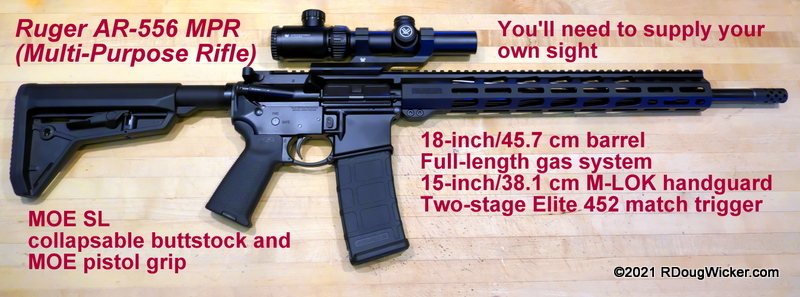
  • Barrel: 18 inches/45.7 cm
  • Barrel twist: 1:8, 5-groove, right hand
  • Barrel forging and metallurgy: Cold hammer-forged; 4041 chromium-molybdenum alloy steel; nitride lining
  • Barrel attachment thread pattern: ½”x28
  • Lower specifications: CNC-machined 7075-T6 aluminum forgings; Type III (Mil-Spec) hard coat anodization
  • Sights: None included in keeping with the free-floating barrel design
Barrel on the AR-556 in 5.56 NATO/.223 Remington comes with a 1-in-8 twist

Other included goodies:
  • Trigger: Ruger’s Elite 452® two-stage trigger (a huge plus for this rifle) with a claimed 4.5-pound/2-kilogram pull
  • Accessory Rail: Full length Picatinny M1913 rail
  • Handguard: 15-inch/38.1 cm free-floating Magpul® handguard with:
    • M-LOK® Slots at 3, 6, and 9 O’clock (eight slots per O’clock position)
    • Additional single M-LOK slots at 1:30, 4:30, 7:30, and 10:30 positions
  • Buttstock: Magpul MOE® (Magpul Original Equipment) SL® (Slim Line) collapsible buttstock
  • Pistol grip: Magpul MOE grip
  • Capacity: The MPR comes with one 30-round Magpul PMAG® Gen-2 MOE magazine (a pet peeve of mine; come on, Ruger, you can do better than just one magazine)
  • Owner’s Manual: Of course
  • Safety lock: Cable type key lock
  • Box: Cheap cardboard, of course
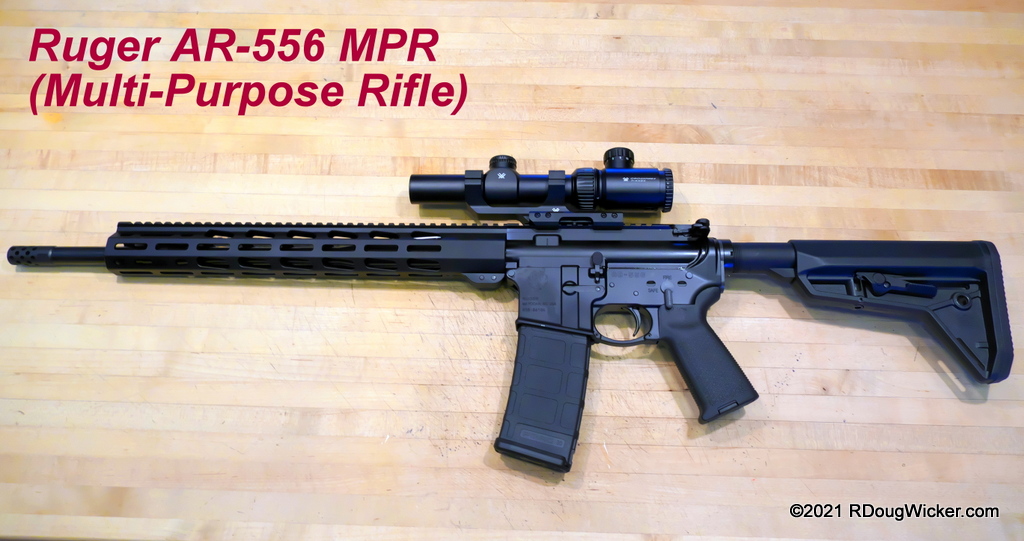
Ruger AR-556 MPR

Now let’s take a look at the rifle.  First off, that scope you see mounted does not come with the AR-556 MPR. Indeed, since this rifle has a free-float barrel, it does not come with a sight of any type — not even the usual combination gas block/front sight most associated with this type of rifle. As such, you’ll have to cough up some money upfront to fix that. The scope you see mounted here is a Vortex Crossfire II 1-4×24 with Vortex’s V-Brite red dot.

Barrel is free-floating

Also not included was the two-point sling you see pictured, nor the M-LOK Quick Dismount (QD) rail attachment. The MOE SL buttstock does however have a QD attachment point, in addition to a slot for your sling if you prefer.

Magpul MOE SL collapsible butt stock

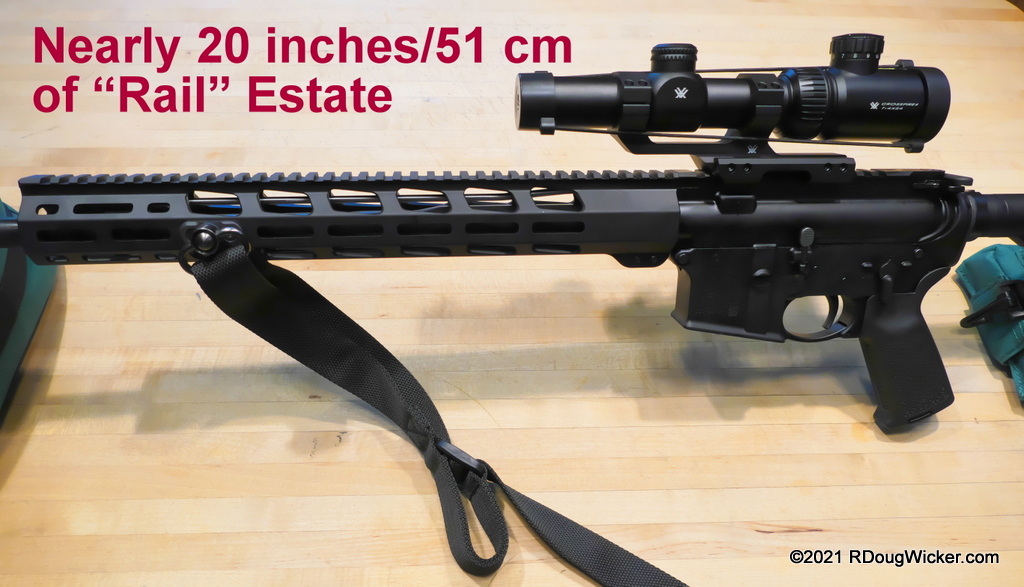
But no matter what sight you choose to mount, there’s nearly 20 inches/51 cm of slot “rail” estate along the rail atop the MPR’s flat upper receiver. Go with iron sights, red dot, red dot with magnifier, low-power scope, high-power scope, night scope, or even optics co-witnessed with iron sights if you wish. The options are limited only by your imagination and your wallet.

Nearly 20 inches of rail for lots of customization options

Now, what about Ruger’s claimed 4.5-pound/2.04 kg Elite 452 trigger? Turns out they fudged on that one. The pull worked out closer to 4.17 pounds, but I’m not going to quibble when it’s to my advantage. The actual five-pull average came in at a mere 4 pounds 2.7 ounces/1.89 kg. Trigger reset is so miniscule I had trouble measuring it, but my best eyeball guesstimate puts it at around an eighth of an inch, or about 3 mm.

Magpul MOE pistol grip

I’ve yet to fire the AR-556 MPR, so I haven’t even had the opportunity to sight in the Crossfire II. But I can tell you how I perceive the handling characteristics thus far. The MPR is well balanced and easy to handle. It’s both light and comfortable to carry, and quick to get on target when the sling is properly adjusted. All controls are just where one would expect on any AR-style rifle, so there are no surprises here and they are all easy to manipulate . . . if you’re righthanded; none of the controls are ambidextrous.

No ambidextrous controls on this rifle
Controls

Fit and finish I would rate as good. The MPR certainly looks good. There was one minor flaw in the hard coat anodization on the edge of the magazine well (see below). But that’s a quibble. It’s not worth the time and effort for a trip back to the mothership for a rifle that is meant to be used.

A word of caution: make sure you disassemble your MPR and check for copious amounts of lubrication. One of the things I really appreciate about Ruger is that they way overengineer nearly everything they make, but they also love to overlubricate. In the case of this MPR, there was far too much lubricant inside the bolt carrier and on the tail of the bolt. I hate to think how much carbon would have cooked onto those surfaces if I hadn’t wiped them down. Other areas were positively dripping with lubrication as well, but that’s been remedied.

Ruger’s fit and finish almost got an A+, except for this

Overall, I’m impressed. But then I’m also a novice in the AR market, so there’s that. Perhaps I’m just easily impressed. But I don’t believe that’s the case here. For all the features Ruger threw into this AR-556 variant, the MPR is an impressive rifle at a price point hundreds less than anything comparable in a nationally known and respected brand.

Ruger AR-556 MPR

That concludes this week’s firearms series. If you’re not a fan, do not despair.

Next week this blog returns to travel the photography. That series will start in Ireland, head transatlantic with a stop in Ponta Delgada in the Azores, continue into Key West for some sunset photos, then head over to the Mayan ruins of Chichen Itza on the Yucatán Peninsula.

Comments Off on Fun Firearms Friday — First Look: Ruger® AR-556® MPR

Filed under Firearms, Fun Firearm Friday