Category Archives: Firearms

The Perfect Fashion Accessory—Walther PPK in .32 ACP


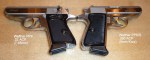
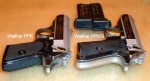
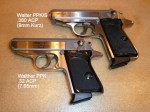
Today I’ll be mortally wounding two fowl with one projectile, so to speak.  I’ve been promising my online pals over at Walther Forums a review of my new .32 ACP Walther PPK, and today I’ll be comparing that pistol with my earlier acquisition, a .380 ACP Walther PPK/S.  (Sad note:  The .32 version of both the PPK and PPK/S were discontinued in the spring of 2013)

Both the PPK and PPK/S are derived from Walther’s PP, first produced in 1929 and initially developed for the .32 ACP cartridge (or 7.65mm, as it’s known in Europe).  As such and in conjunction with the design’s blowback operation, the much more powerful .380 ACP (or 9mm Kurz) iteration can be a real bear when it comes to recoil.  But not so with the originally intended .32 ACP cartridge.  With this round, the PP-series becomes a very controllable weapon that is a real joy to shoot over extended range sessions.

This is made even more so by the Smith & Wesson redesign and enlargement of the tang, or beavertail, at the rear of the gun, located just below the hammer and directly above the grip.  Indeed, this redesign significantly improved the shootability of even the .380 ACP version, allowing for relatively pain-free range sessions well in excess of 100 rounds.  This enlarged tang also seems to allow for better recoil management and quicker reacquisition of the target for faster follow-up shots.

That enlarged tang provides additional protection to the hand from the rearward travel of the slide—the infamous “Walther bite,” in which the slide on older versions would sometimes contact the upper portion of the hand above the web between the thumb and forefinger, causing two parallel but minor wounds to appear if you weren’t careful in your grip of the pistol.

But it hasn’t been all good news with the Smith & Wesson version of this classic pistol.  They got the tang right.  They also redesigned the feed ramp to make the pistol more reliable in loading modern defensive ammunition such as hollow points.  They even attempted to reduce the heavy double-action pull by tinkering with the internals, however this is where Smith & Wesson notoriously screwed up, and that resulted in the recall of every PPK/S and PPK pistol S&W made over an eight-year period.  Apparently, this well-intentioned redesign led to sporadic failures of the hammer block safety mechanism, which could (and occasionally did) result in the pistol inadvertently firing when the safety was engaged while the hammer was in the cocked position.  Not good.  And then there were numerous reports of the pistols coming back from S&W far less reliable than they were before making the recall trip.  Also not good, especially if you rely upon your PPK/S or PPK for defense.

Fortunately, both my PPK/S and my more recently acquired PPK are of post-recall manufacture, and both have so far proven reliable after initial break-in.  Both pistols took approximately thirty rounds before they settled down and functioned reliably, but it’s still too early for me to say that I would trust the PPK, as I’ve only put around 130 rounds through it as of this report.  As for the PPK/S, I’ve had only two failures to properly feed ammunition in nearly 800 rounds.  One of those malfunctions occurred when someone else was firing the pistol, so that particular failure may be attributable to any of several operator-induced problems.

Now for the actual firing of the PPK in .32 ACP:  As previously noted, this is the caliber for which this weapon was designed, and it shows.  Recoil is light and manageable, follow-up shots are quick, and accuracy is exceptional.  My PPK/S has always been the handgun with which I am most accurate, but this PPK proved its equal in my tests.  Simply put, it’s just darned hard to miss with these pistols.  The grip is so natural and the aim of them is so intuitive that using the sights almost seems an afterthought when it comes to acquiring your intended target.  I find that I can reliably place headshots at a range of seven yards (6.4 meters) all day long, and center mass shots are easy to perform at over twice that distance.  Try that with the new breed of double-action only compacts coming out on the market today.  And combining that incredible accuracy with the lighter recoil associated with the .32 ACP round and the improvements in the enlarged tang at the rear means that follow-up shots can be performed very quickly.

I simply cannot express how pleased I am with this double-action/single-action pistol.  If it continues to prove reliable after additional testing, I may very well place it in my concealed carry rotation along with my .380 ACP PPK/S and my 9mm Walther P99c AS.  I may also find myself recommending the .32 ACP PPK to recoil-sensitive individuals looking for a compact, easy to conceal weapon that can fit in anything from a small purse to even the occasional pocket.  And if that lady in your life gets the flinches from firing larger caliber weapons, this could very well be the handgun of her dreams.  The elegant lines and art deco styling are wardrobe friendly, making this a wonderful fashion accessory.

Click on the photographs below for larger views and additional information:
7 Comments

Filed under Firearms

Firearms for Formulators of Fiction—Semiautomatics Part 2


Today we continue our look at semiautomatics, and give tips for fiction writers incorporating these weapons into their stories.

Since the advent of the Glock, many gun manufacturers have since come out with their own polymer-framed pistols and many have emulated the Glock trigger.  Others have gone a different route, coming out with polymer pistols that retain the traditional hammer, single-action/double-action trigger, and manually operated external safety.  Others have dropped the external safety, choosing to rely upon a long, stiff, double-action first pull on the trigger to increase handling safety and reduce the chances of an unintended discharge.

My personal favorite of these post-Glock weapons is the Walther P99 AS.  The P99 AS (anti-stress) is a polymer-framed semiautomatic pistol that incorporates an internal striker with a trigger that has three modes—a long, stiff double-action mode; a light, short single-action mode; and a long, light “anti-stress” mode.  This “anti-stress” trigger mode is what the weapon defaults to when the slide is racked to chamber a round.  A de-cocking button atop the left rear portion of the slide de-cocks the striker and places the P99 in double-action mode for safer carry.

Lately, a new breed of semiautomatics have begun to flood the market.  These are light-weight, medium- to large-caliber, polymer-framed, striker-fired, double-action only subcompacts that are very easy to hide.  In other words, these are the logical evolution of early “pocket” pistols such as the Walther PPK, only they are smaller, lighter, and equipped to fire more powerful ammunition.  However, because of their double-action triggers, these weapons are generally not very accurate beyond close range and they sacrifice capacity in favor of larger caliber ammunition.  Examples include the Ruger LC9, The Kahr P-series, the Kel-Tec P-11, and the Rohrbaugh R9.

Common mistakes and misconceptions involving semiautomatics:

How many times on television and in the movies have you seen somebody “unload” a semiautomatic by removing the magazine and then handing the pistol back to the person who was carrying it?  A lot, right?  Well, guess what—that still leaves one round in the chamber of the pistol unless the person “unloading” it also racks back on the slide, ejecting the cartridge.  This means that supposedly “unloaded” gun can still fire one round . . . unless the gun is one of the recent crop of weapons that has a magazine disconnect that renders it inoperable as soon as the magazine is removed.  The excludes the vast majority of all semiautomatics currently in circulation.

Is your character walking around with his finger on the trigger?  Don’t let him do that!  It’s dangerous.  Modern Glock-style triggers and the light, short triggers of recent single-action only weapons such as the new Walther PPQ have only amplified this danger.  The proper way for your character to hold his weapon is with the trigger finger resting above the trigger, along the lower frame of the weapon just below the slide.  When your character visually acquires and sights in on his target then—and only then— should he shift his finger to the trigger in anticipation of  firing the weapon.

I cringe whenever the hero has exhausted all his bullets and pulls back on the trigger only to be greeted by the deafening sound of a dull, metallic click and no “bang.”  That’s not the way it works with a semiautomatic.  When semiautomatics have fired their last shot, the slide locks back leaving the chamber open and the barrel exposed.  That’s to facilitate a fast reload.  When this happens, the shooter hits the magazine eject (this can be a button on the frame, a lever built into the trigger guard, or a catch built into the base of the butt), the spent magazine falls to the ground, and a loaded magazine is inserted into the grip.  If there is danger still about, the experienced shooter will ram the magazine into the grip (magazine well) forcefully and immediately chamber a round by either thumbing the slide release, if the gun is so equipped, or pulling back on the slide so that the slide catch drops away from the slide.  What cannot happen when the last shot is fired and the slide is locked back is for the hero to hear that frightening “click,” to which our hero inevitably replies, “Oh, heck!”  The hammer or striker simply will not function with the slide locked back.

How many times have you seen the hero show you, the audience, that he’s ready to take on the bad guys by racking back the slide and chambering a round?  Looks cool.  Sounds even cooler.  Shows he means business.  Or does it?  If your character is just now, in the face of imminent danger, chambering a round into the pistol’s firing chamber, he’s already far too late.  Experienced gun carriers would never dream of leaving their house without, “one in the pipe.”  If police officers needed to charge their weapons to ready them for firing, there would be a lot more dead cops on the street.  Same with everyone from Ferrari-driving private detectives in Hawaii to suave spies dressed in tuxedos and playing baccarat in European casinos.  In the real world, it’s simply not done . . . except in Israel.  There, the heavily armed civilian populace is trained to draw, rack, aim, and fire, and through extensive practice most of them are very good at it.  But if your character isn’t Israeli, forget the dramatics and go with the more commonly accepted practice.

But don’t confuse that with the gun toter who pulls back just slightly on the slide and peers into the chamber.  This is called a “brass check,” and it’s a way of visually verifying that a round is in the chamber.  If your character has ample time to do this before entering into a dangerous situation, then you’ve shown your audience that this guy really knows his stuff—he’s double checking that his weapon is ready before he needs it.

Additional tips:

Know your weapons.  I simply cannot stress this enough.  Recently, a fellow writer solicited opinions about a new book cover for their novel.  The title of the novel contained the name of a fairly recent producer of modern firearms, but when I took a look at the cover I noticed an error that reached out and slapped me across the face.  The gun on the cover, a black silhouette against a light background, was not a modern firearm.  It was instead the silhouette of one of the most famous guns ever made—a German Luger P08.  The Luger was a weapon first produced in 1900 and used by the German military from 1909 until 1945!  Fortunately, alerted to the mistake, this author was able to get their design artist to change the profile of the weapon so that it matched the make mentioned in the title of the book.  Whew!  Close call.  Just dodged that bullet.

Where does a writer go to learn what they need to know to make their handgun scenes believable?  That’s easy.

Visit your local gun shop and talk to the owner.  Not the salesman.  The owner.  The store owner is probably a gun enthusiast who knows his stuff.  That sales clerk may not, and many will give you bad information.

Go to the local police department.  They are, obviously, proficient in firearms, and many of them are gun enthusiasts.

Take a trip to the local shooting range.  These people not only love to shoot, they love to talk guns and they will talk off your ear answering your questions and giving you their opinions on various weapons.  And, boy, do they have opinions.  Glock fanboys versus Glock haters.  Sig lovers versus H&K (Heckler & Koch) devotees.  Walther PPK versus the Bersa Thunder or Firestorm.  1911 people against practically everybody else.  The opinions will rain down on you nonstop.  But don’t forget ear and eye protection, because . . .

While you’re at that range, ask somebody to show you how to handle a gun and ask them to let you try firing a weapon or two (politely offer to reimburse the owner for the cost of the ammunition).  Experience firsthand the dynamics of shooting a handgun, from loading the weapon to the intricacies of manipulating the controls.  From the proper techniques for holding the weapon, to the art of sighting and aiming at your target.  From the feel of the trigger and the precise moment it trips, to the sudden recoil that pushes the gun back into your hands and raises the barrel upward.  Learn this last dynamic well, as it directly impacts how fast you (and consequently your character) can reacquire the target for a follow-up shot if necessary.

After you’ve done that, ask your new-found friends to show you what can go wrong with a semiautomatic, and how to most expeditiously fix a malfunction and bring the weapon back online—from the tap, rack, bang drill to a more detailed tear down and clearing of the weapon.

You may not like handguns.  You may even loathe them.  But if you’re going to use them in your writing, then you owe it to your readers to get it right.  If you don’t, you stand to lose a significant portion of your potential audience and damage your credibility on other points of detail in your story.  And the only way to get it 100% correct is to actually get your hands on a semiautomatic or revolver and try it for yourself.

Who knows?  You might find you even enjoy it.  I know I certainly do:

Weapons:

Walther P22 target pistol (.22LR)
Interarms Walther PPK/S chambered in .380 ACP (9mm Kurz)
Smith & Wesson Walther PPK/S chambered in .380 ACP (9mm Kurz)
Smith & Wesson Walther PPK chambered in .32 ACP (7.65mm)
Walther P99c AS chambered in 9mm Parabellum
Taurus PT 24/7 Pro DS (double-action/single-action) chambered in .45 ACP

Holsters:

Don Hume H721 “Double Nine” fitted for the Walther PPK and PPK/S
Don Hume H721 “Double Nine” fitted for the Walther P99 and P99C
Galco Miami Classic Shoulder Rig fitted for the Walther P99 and P99c

4 Comments

Filed under Author, Firearms, Writing

Firearms for Formulators of Fiction—Semiautomatics Part 1


Today’s blog entry is a continuation of a series I began on Monday—a look at what fiction writers need to know about handguns.  First, we discussed revolvers, and today we begin a two-part look at semiautomatics.

But first, in continuing with Monday’s numbers theme, how many Californians does it take to change a lightbulb?  Six:  One to actually change the bulb, two to share in the experience, another to bring the tofu, and two more to present the award for best technical achievement in lighting.

So, how many kinds of semiautomatic handguns are there?  A lot:  Single- action only; double-action only (DAO); single/double-action; partially cocked striker.  And that’s just triggering systems.  Then there’s the traditional metal-framed pistols and the newer polymer frames, traditional hammer pistols and newer striker types, semiautomatics with manually operated external safeties and the recent trend popularized by Glock to eliminate such safeties.

Let’s start with single-action (SA) semiautomatics.  Just as with single-action revolvers, single-action semiautomatics require the hammer to be cocked before the weapon can be fired.  On subsequent shots, the hammer is cocked by the action of the slide moving back to eject the spent cartridge, after which a new cartridge is stripped off the top of the magazine and fed into the firing chamber as the slide returns forward.  But, unlike the single-action revolver, this type weapon is usually designed to be safely carried with the hammer in the cocked position because it comes equipped with a manual safety that prevents the weapon from firing unless the safety is disengaged.  This is what is described as, “Cocked and locked.”  So, now you know the origination of this famous phrase.  Most single-action only weapons are designed to do this.

The most famous example of this type weapon is John Browning’s century-old design, the .45 caliber Colt M1911.  You would be hard pressed to watch an action movie or television show in which at least one character doesn’t produce one of these weapons.  The 1911 was the weapon of choice for fictional heroes from Mike Hammer to Magnum, P.I., and it’s still manufactured today.

Just as revolvers evolved from straight single-action to combination double-action/single-action, semiautomatics did as well.  With a double-action/single-action pistol, the hammer can either be manually cocked (single-action), or the pulling the trigger will cause the hammer to pull back into firing position (double-action).  The most famous of these is probably the Walther PP-series.  Indeed, this pistol is one of the most copied designs ever produced, probably coming in second only to the Model 1911 described above.

Who in literature used a PP-series pistol?  Bond . . . James Bond—also known in some circles as agent OO7 of Her Majesty’s Secret Service.  James Bond made the switch to the smallest version of the PP-series, the PPK, after his original carry piece, the Beretta 418, nearly costs him his life at the conclusion of the novel From Russia with Love.  In television, the PPK was used by Magnum, P.I., as a backup piece, and the slightly larger PPK/S was used by Robert McCall in The Equalizer, Sgt. Dee Dee McCall in Hunter, and more recently by Fiona Glenanne in Burn Notice.

In 1979 an Austrian company set out to revolutionize the modern semiautomatic pistol, and in 1982 they launched the Glock 17.  The Glock series of pistols were pretty unique.  The frames were made of light-weight polymer, reducing the weight of the gun considerably.  Gone was the hammer, replaced by an internal striker (basically a spring-loaded firing pin) that was less likely to snag on clothing when drawn.  Also missing from the Glock design were any manually operated external safeties.

And then there was the Glock trigger action—not single-action and not double-action, it held a sort of middle ground between the two in that the striker was partially cocked.  Pulling the trigger would complete the cocking of the striker until the trigger reached the trip point, at which time the internal striker would move forward under spring tension, striking the primer of the bullet.  This Glock-style trigger is not as stiff and long as a double-action trigger, but neither is it as short and light as a single-action trigger.

Friday: Firearms for Formulators of Fiction—Semiautomatics Part 2

1 Comment

Filed under Author, Firearms, Writing