
A couple of years ago I wrote a book about what happened to the Federal Aviation Administration under the direction of whom I personally believe to be the most incompetent and destructive administrator to ever head the Agency. Alas, my agent was unable to find a major publisher willing to publish this book. Some deemed it too terrifying. Others said that no one who flies would want to read it, thus limiting its marketability. But the one thing nearly every editor agreed upon was that they couldn’t put the book down and that it scared the heck out of them.
Two of the chapters in this book became relevant yet again this past week when for the second time in less than twenty-one months a Southwest Airlines Boeing 737 experienced a breach in the fuselage while flying above 30,000 feet. The first was Southwest Flight 2294 on July 13, 2009. The second occurred just days ago, on April Fools’ Day, aboard Southwest Flight 812.
A lot of this goes back to Marion Blakey’s reign of error at the FAA, in which her subordinates were told in no uncertain terms that she considered the Agency’s “customers” to be the airlines. Yes, you read that correctly. You, the flying passenger, were not her concern. The airlines were. As such, FAA inspectors suddenly found themselves facing disciplinary action or even termination if they did their jobs and found airline maintenance lacking. There were in fact numerous instances of this occurring throughout her tenure and beyond. And while the Administrator has changed, those whom she placed in what I laughingly call “positions of responsibility” are still deeply embedded and destroying the Agency from within.
So, with this second Southwest near-disaster making news, prepare to be terrified as I bring to you Chapter Two of the book that never was, The Tombstone Agency. The outrage part will follow on Wednesday, with the posting of the first part of Chapter Five.
Chapter Two
Why Inspectors Inspect Airplanes—
Death and Near Disaster Over Maui
Out of the ninety-five passengers and crew boarding the airliner that day only Gayle Yamamoto garnered so much as a hint of the disaster about to strike Aloha Airlines Flight 243. It was April 28, 1988, when she boarded the Boeing 737 200-series aircraft at Hilo International Airport for the scheduled flight to Honolulu. As she approached the passenger doorway her eyes fell onto a small but very visible crack just aft of the hatch opening. Shrugging off the observation for whatever reason, perhaps thinking nothing was amiss or not wanting to appear an unduly nervous passenger, she kept silent about her observation as she passed by the flight attendants on the way to her assigned seat.
This Boeing 737, U.S. registration N73711, was unique. It wasn’t all that old, a mere nineteen years since manufacture, but it was positively ancient in terms of fuselage pressurization cycles. When a jetliner takes off and climbs into the thin air of high altitude, the fuselage is pressurized to an atmospheric pressure equal to about 8,000 feet. When the aircraft descends, the fuselage is allowed to equalize to the outside atmospheric pressure. You feel these changes in pressure on your eardrums after takeoff and again as the plane descends for arrival, but the fuselage is under much higher stress than your eardrums. It cannot ever allow an equalization of pressure at high altitude. People would lose consciousness within seconds from the lack of oxygen. They could experience irreversible brain damage or even die very shortly thereafter.
Because of the short-haul nature of interisland travel, N73711 had gone through 89,680 cycles during its relatively short history. That’s over 14,000 cycles beyond the 75,000 cycles for which it was designed. That’s an average of almost thirteen cycles every day of every year for nineteen years. In subsequent, world-wide inspections, only one jet airliner would be found with a higher number of cycles. N73711 was also operating in a highly corrosive environment—the salty sea air associated with any oceanic island or coastal area—which only exacerbated the potential for problems. N73711’s luck was about to run out.
Twenty-three minutes into the flight, at 24,000 feet above the sea, that little crack noticed by Gayle Yamamoto opened enough to allow air to escape from within the pressurized fuselage into the relative atmospheric vacuum outside. Standing in Row 5 just a few yards back from the opening, Senior Flight Attendant Clarabell ‘C.B.’ Lansing collected cups from the earlier beverage service. The small crack widened suddenly, becoming a large and growing hole. Catastrophic rapid decompression of the passenger compartment had begun.
Cups, magazines, newspapers, eyeglasses, every light object in the aircraft rushed toward the breach. Larger objects closer to the hole were also picked up, including Ms. Lansing who suddenly found herself airborne. Her body slammed against the fuselage, plugging for a few milliseconds the hole that threatened the aircraft, but this only briefly interrupted the destruction that had begun.
The outer metal skin of the fuselage peeled back along the controlled area breakaway zones, cleanly stripping the roof of the aircraft from above the first five passenger rows all the way down to the floor of the passenger cabin. Passengers saw only clear, blue skies above and to either side as the oxygen expelled from their lungs. Passengers in the window seats suddenly found nothing beside them except a terrifying view of the Pacific Ocean and Hawaiian Island chain over four miles below. C.B. Lansing disappeared from the cabin as though she had never been aboard, cast into the void. Her body would never be recovered.
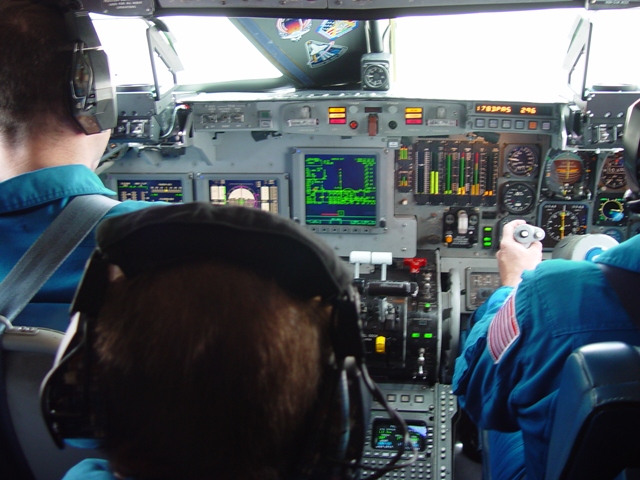
In the cockpit Captain Robert Schornsteimer occupied the command seat. First Officer Madeline ‘Mimi’ Tompkins sat to his right. There would normally be only two people in N73711’s cockpit. On this day there were three. Riding in the jump seat behind the pilot was a Hawaiian-based FAA Air Traffic Control Specialist who was taking an FAA-authorized familiarization flight. His flight was free but, as is frequent in life, you get what you pay for.
The first indication in the cockpit that something was amiss was a loud clap and a sudden rush of wind. Every mote of dirt and dust in the cockpit lifted into the air along with bits of insulation material, briefly obscuring visibility. Captain Schornsteimer glanced over his right shoulder. The cockpit door was missing, and beyond that was the incredible sight not of the ceiling above the passenger cabin, but rather clear, blue sky. He lunged for his oxygen mask and thrust it over his face. First Officer Tompkins parroted his action as did the Controller sitting behind them. The occupants of N73711 were lucky so far. Because of the short route, they were at only 24,000 instead of the much more dangerous higher altitudes at which Boeing 737 aircraft normally fly.
Schornsteimer nosed the aircraft over into an emergency dive in a desperate struggle for denser, life-sustaining, oxygen-rich air. The control column shook violently in his hands as N73711 picked up speed and the disrupted airflow pounded into the vast opening behind him. He throttled back the engines and deployed the speed brakes to keep from exceeding the maximum design airspeed and additionally overstressing the already compromised airframe. The aircraft wallowed from side to side like a circus clown atop a board balanced on a ball. The controls were mushy, responding slowly to his inputs. A glance at the instruments told him that engine number one had failed, probably having ingested debris from the disintegration of the fuselage.
Acting autonomously Tompkins dialed the emergency code into the transponder. She transmitted a distress radio call to Honolulu Air Route Traffic Control Center (ARTCC). The noise level made it impossible for her to hear any replies or for Air Traffic Control at the other end to understand her transmissions. However the ARTCC Controller did know that something had placed Flight 243 in danger. The emergency transponder code, 7700, flashed on his radar display over the location of the aircraft and its remaining ninety-four occupants.
As the stricken Boeing descended through 14,000 feet Tompkins dialed in the frequency for the Control Tower at Kahului Airport on Maui. For the first time since their ordeal began she was able to establish direct two-way radio communications with Air Traffic Control. The Tower Controller acknowledged the emergency condition and directed Tompkins to reset her transponder so as to establish radar identification. The ‘crash phone’ was activated by Control Tower personnel, sending emergency response vehicles to positions along the runway.
In an amazing display of piloting, Robert Shornsteimer and Mimi Tompkins brought the severely damaged Boeing, minus eighteen feet of critical roof and side cabin structure and with one engine not working, safely back to Earth with no additional fatalities.
Aftermath—Lessons Learned
The final toll was one fatality, eight serious injuries (several life-threatening), and fifty-seven minor injuries. Had the failure occurred just a few thousand feet higher many more would have died, and in all likelihood the aircraft would have been unrecoverable. As it was, N73711 was a total loss that would never again take to the skies.
Recommendations made in the wake of the investigation led to the retirement of many older jet aircraft around the world. Inspections were increased and mandated for all aircraft at regular intervals. The legacy of Aloha Flight 243 is that it represents a major change in philosophy in aircraft life-expectancy, maintenance, and the importance of inspecting for metal fatigue. It is incredibly fortunate that the lessons learned came at so low a price in terms of lost lives. This is not usually the case, as evidenced by the nickname given the Federal Aviation Administration by pilots and industry insiders decades ago—The Tombstone Agency. Usually, such changes come only after much higher body counts.
Twenty Years Later—Lessons Forgotten
On March 6, 2008, the FAA proposed a record $10.2 million fine against the highly respected Southwest Airlines for failing to inspect its aircraft. But the really disturbing news was to come almost one week later. Six days after the proposed fine was announced Southwest suddenly grounded forty-three Boeing 737 aircraft. Required safety inspections had not been performed, yet those aircraft continued to fly for almost a week after the lapse was exposed. Worse, the inspections skipped had been for the precise cause of the Aloha 243 mishap—metal fatigue. It was soon revealed that Southwest was not alone. Fatigue inspections had not been performed at other airlines, including Delta.
But the most startling revelation was yet to come. The lapses at Southwest Airlines had not been uncovered just one week before as the press were misled to believe by FAA spokespersons. In actuality, Inspectors from the FAA’s Flight Standards District Office (FSDO) in Dallas, Texas, informed their superiors of inspection lapses one year before. In March, 2007, these inspectors advised their superiors that several of Southwest’s Boeing 737 fleet were beyond required inspection timelines, yet no enforcement action was taken. Indeed, Southwest was left with the impression that the FAA had given implied approval to continue to delay required fatigue inspections until the aircraft were taken out of rotation for normal, routine servicing. There was not the slightest hint of urgency from the agency. So it was quite understandable that Southwest’s spokesperson expressed outrage that the FAA had proposed a record fine since agency personnel were in fact aware of the lapses and had taken no enforcement action for one full year.
From the time FAA inspectors revealed to their superiors the lack of inspections at Southwest until the time Southwest announced the grounding of part of its fleet, the airline had operated 59,791 flights using forty-six aircraft considered unsafe by the FAA’s own regulations. If one conservatively estimates an average load factor of ninety passengers and crew for those 59,791 flights, then almost 5,400,000 people were placed unnecessarily in danger. And something else to consider—Southwest’s routes are generally longer than Aloha’s. Thus Southwest’s Boeing 737 aircraft are operated at considerably higher altitudes, exposing the fuselages to much higher pressures, and the occupants to much greater dangers in the event of a fuselage failure.
Eventually, the FAA agreed to reduce the fine to $7.5 million dollars paid in three installments through the year 2011. In other words, Southwest got off paying just $125.44 per illegal flight, or about $1.39 per endangered passenger and crew.
(To be continued)
copyright © 2011 R. Doug Wicker
No portions of this article are to be used, quoted, copied, or retransmitted without the permission of the author.
Chapter Two
Why Inspectors Inspect Airplanes —
Death and Near Disaster Over Maui
Out of the ninety-five passengers and crew boarding the airliner that day only Gayle Yamamoto garnered so much of a hint of the disaster about to strike Aloha Airlines Flight 243. It was April 28, 1988, when she boarded the Boeing 737 200-series aircraft at Hilo International Airport for the scheduled flight to Honolulu. As she approached the passenger doorway her eyes fell onto a small but very visible crack just aft of the hatch opening. Shrugging off the observation for whatever reason, perhaps thinking nothing was amiss or not wanting to appear an unduly nervous passenger, she kept silent about her observation as she passed by the flight attendants on the way to her assigned seat.
This Boeing 737, U.S. registration N73711, was unique. It wasn’t all that old, a mere nineteen years since manufacture, but it was positively ancient in terms of fuselage pressurization cycles. When a jetliner takes off and climbs into the thin air of high altitude, the fuselage is pressurized to an atmospheric pressure equal to about 8,000 feet. When the aircraft descends, the fuselage is allowed to equalize to the outside atmospheric pressure. You feel these changes in pressure on your eardrums after takeoff and again as the plane descends for arrival, but the fuselage is under much higher stress than your eardrums. It cannot ever allow an equalization of pressure at high altitude. People would lose consciousness within seconds from the lack of oxygen. They would die very shortly thereafter.
Because of the short-haul nature of interisland travel N73711 had gone through 89,680 cycles during its relatively short history, over 14,000 cycles beyond the 75,000 cycles for which it was designed. That’s an average of almost thirteen cycles every day of every year for nineteen years. In subsequent, world-wide inspections, only one jet airliner would be found with a higher number of cycles. N73711 was also operating in a highly corrosive environment —— the salty sea air associated with any island or coastal area —— which only exacerbated the potential for problems. N73711’s luck was about to run out.
Twenty-three minutes into the flight, at 24,000 feet above the sea, that little crack noticed by Gayle Yamamoto opened enough to allow pressure to escape from within the pressurized fuselage into the relative atmospheric vacuum outside. Standing in Row 5 just a few yards back from the opening Senior Flight Attendant Clarabell ‘C.B.’ Lansing collected cups from the earlier beverage service. The small crack widened suddenly, becoming a large and growing hole. Catastrophic rapid decompression of the passenger compartment had begun.
Cups, magazines, newspapers, eyeglasses, every light object in the aircraft rushed toward the breach. Larger objects closer to the hole were also picked up, including Ms. Lansing who suddenly found herself airborne. Her body slammed against the fuselage, plugging for a few milliseconds the hole that threatened the aircraft, but this only briefly interrupted the destruction that had begun.
The outer metal skin of the fuselage peeled back along the controlled area breakaway zones, cleanly stripping the roof of the aircraft from above the first five passenger rows all the way down to the floor of the passenger cabin. Passengers saw only clear, blue skies above and to either side as the oxygen expelled from their lungs. Passengers in the window seats suddenly found nothing beside them except a terrifying view of the Pacific Ocean and Hawaiian Island chain over four miles below. C.B. Lansing disappeared from the cabin as though she had never been aboard, cast into the void. Her body would never be recovered.
In the cockpit Captain Robert Schornsteimer occupied the command seat. First Officer Madeline ‘Mimi’ Tompkins sat to his right. There would normally be only two people in N73711’s cockpit. On this day there were three. Riding in the jump seat behind the pilot was a Hawaiian-based FAA Air Traffic Control Specialist who was taking an FAA-authorized familiarization flight. His flight was free but, as is frequent in life, you get what you pay for.
The first indication in the cockpit that something was amiss was a loud clap and a sudden rush of wind. Every mote of dirt and dust in the cockpit lifted into the air along with bits of insulation material, briefly obscuring visibility. Captain Schornsteimer glanced over his right shoulder. The cockpit door was missing, and beyond that was the incredible sight not of the ceiling above the passenger cabin, but rather clear, blue sky. He lunged for his oxygen mask and thrust it over his face. First Officer Tompkins parroted his action as did the Controller sitting behind them. The occupants of N73711 were lucky so far. Because of the short route, they were at only 24,000 instead of the much more dangerous higher altitudes at which Boeing 737 aircraft normally fly.
Schornsteimer nosed the aircraft over into an emergency dive in a desperate struggle for denser, life-sustaining, oxygen-rich air. The control column shook violently in his hands as N73711 picked up speed and the disrupted airflow pounded into the vast opening behind him. He throttled back the engines and deployed the speed brakes to keep from exceeding the maximum design airspeed and additionally overstressing the already compromised airframe. The aircraft wallowed from side to side like a circus clown atop a board balanced on a ball. The controls were mushy, responding slowly to his inputs. A glance at the instruments told him that engine number one had failed, probably having ingested debris from the disintegration of the fuselage.
Acting autonomously Tompkins dialed the emergency code into the transponder. She transmitted a distress radio call to Honolulu Air Route Traffic Control Center (ARTCC). The noise level made it impossible for her to hear any replies or for Air Traffic Control at the other end to understand her transmissions. However the ARTCC Controller did know that something had placed Flight 243 in danger. The emergency transponder code, 7700, flashed on his radar display over the location of the aircraft and its remaining ninety-four occupants.
As the stricken Boeing descended through 14,000 feet Tompkins dialed in the frequency for the Control Tower at Kahului Airport on Maui. For the first time since their ordeal began she was able to establish direct two-way radio communications with Air Traffic Control. The Tower Controller acknowledged the emergency condition and directed Tompkins to reset her transponder so as to establish radar identification. The ‘crash phone’ was activated by Control Tower personnel, sending emergency response vehicles to positions along the runway.
In an amazing display of piloting, Robert Shornsteimer and Mimi Tompkins brought the severely damaged Boeing, minus eighteen feet of critical roof and side cabin structure and with one engine not working, safely back to Earth with no additional fatalities.
Aftermath —— Lessons Learned
The final toll was one fatality, eight serious injuries (several life-threatening), and fifty-seven minor injuries. Had the failure occurred just a few thousand feet higher many more would have died, and in all likelihood the aircraft would have been unrecoverable. As it was, N73711 was a total loss that would never again take to the skies.
Recommendations made in the wake of the investigation led to the retirement of many older jet aircraft around the world. Inspections were increased and mandated for all aircraft at regular intervals. The legacy of Aloha Flight 243 is that it represents a major change in philosophy in aircraft life-expectancy, maintenance, and the importance of inspecting for metal fatigue. It is incredibly fortunate that the lessons learned came at so low a price in terms of lost lives. This is not usually the case, as evidenced by the nickname given the Federal Aviation Administration by pilots and industry insiders decades ago —— The Tombstone Agency. Usually, such changes come only after much higher body counts.
Twenty Years Later —— Lessons Forgotten
On March 6, 2008, the FAA proposed a record $10.2 million fine against the highly respected Southwest Airlines for failing to inspect its aircraft. But the really disturbing news was to come almost one week later. Six days after the proposed fine was announced Southwest suddenly grounded forty-three Boeing 737 aircraft. Required safety inspections had not been performed, yet those aircraft continued to fly for almost a week after the lapse was exposed. Worse, the inspections skipped had been for the precise cause of the Aloha 243 mishap —— metal fatigue. It was soon revealed that Southwest was not alone. Fatigue inspections had not been performed at other airlines, including Delta.
But the most startling revelation was yet to come. The lapses at Southwest Airlines had not been uncovered just one week before as the press was led to believe by FAA spokespersons. In actuality, Inspectors from the FAA’s Flight Standards District Office (FSDO) in Dallas, Texas, informed their superiors of inspection lapses one year before. In March, 2007, these inspectors advised their superiors that several of Southwest’s Boeing 737 fleet were beyond required inspection timelines, yet no enforcement action was taken. Indeed, Southwest was left with the impression that the FAA had given implied approval to continue to delay required fatigue inspections until the aircraft were taken out of rotation for normal, routine servicing. There was not the slightest hint of urgency from the agency. So it was quite understandable that Southwest’s spokesperson expressed outrage that the FAA had proposed a record fine since agency personnel were in fact aware of the lapses and had taken no enforcement action for one full year.
From the time FAA inspectors revealed to their superiors the lack of inspections at Southwest until the time Southwest announced the grounding of part of its fleet, the airline had operated 59,791 flights using forty-six aircraft considered unsafe by the FAA’s own regulations. If one conservatively estimates an average load factor of ninety passengers and crew for those 59,791 flights, then almost 5,400,000 people were placed unnecessarily in danger. And something else to consider —— Southwest’s routes are generally longer than Aloha’s. Thus Southwest’s Boeing 737 aircraft are operated at considerably higher altitudes, exposing the fuselages to much higher pressures, and the occupants to much greater dangers in the event of a fuselage failure.
Eventually, the FAA agreed to reduce the fine to $7.5 million dollars paid in three installments through the year 2011. In other words, Southwest got off paying just $125.44 per illegal flight, or about $1.39 per endangered passenger and crew.










 Decisions — Murder in Paradise
 The Globe — Murder in Luxury
 R. Doug Wicker — Author