
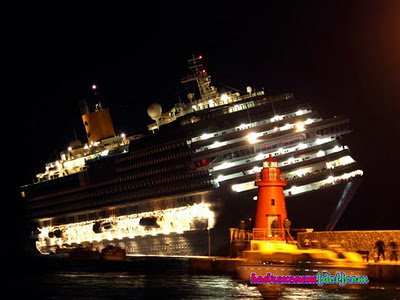
Image Linked from CruiseLawNews
On Monday’s blog I gave you the reported timeline for the Costa Concordia disaster. Let me be very clear that what follows today is entirely speculation on my part and is not be to considered in any way established fact.
Referring back to Monday’s timeline, at 22:00 the Costa Concordia’s bow thrusters were used to turn the ship to the right, initially heading it away from the island of Giglio. This maneuver reportedly aggravated the flooding below decks, substantially increasing the flow of water pouring into the five compromised compartments. But even before this maneuver the ship had already begun listing dangerously to one side. The thrusters were left operating until the ship had turned almost completely around and was very nearly facing in the direction from which it came.

While there remains much for which to blame Captain Schettino, this maneuver is probably the one thing he actually did right that fateful night . . . or did he? Even with the loss of engine power, the Costa Concordia’s momentum kept the ship sailing past the main port on the island of Giglio. Reportedly to slow down the ship, Captain Schettino initially turned the Costa Condordia into the nautical equivalent of a car in a sideways skid, using the natural resistance of the water pushing broadside against the ship to reduce inertial momentum to the point where the thrusters could be used to maneuver. Then, turning the ship broadside to both the current and the prevailing wind, it is speculated that he used both natural forces to assist the thrusters in bringing the Costa Concordia closer into shore and running it aground.


Yet it seems to me unfathomable that Captain Schettino remained levelheaded enough to intentionally perform this maneuver considering all the bad decisions he made leading up to the disaster and, especially, in the aftermath that followed. All his post-collision decision-making to me reeks of panic (and, trust me, having been an air traffic controller for over 34 years and watching how people handle pressure during an emergency, I know panic when I see it). So, while there are many who are crediting Captain Schettino’s ship skidding and thruster maneuver with an attempt to minimize the danger to both passengers and crew, I remain both unconvinced and skeptical that this was indeed the intention.
Yes, I’m a novelist. Yes, it’s my job to spin fantastic tales. So, what follows may very well be a fiction manufactured out of an overactive imagination, but here is my take on what Captain Schettino may have been attempting to do. While the aforementioned maneuver may be consistent with an attempt to beach the ship, it can also be seen at least initially as an attempt to swing the Costa Concordia out into deeper water. And why would someone want to do that considering that the passengers and crew had not been instructed to prepare for evacuation, nor had the lifeboat crews been ordered to their muster stations?
There are reports that officers aboard the Concordia, in what could be construed an act of mutiny, ordered the lifeboat stations manned before authorization came from the bridge. Italian Coast Guard reports would seem to confirm this, as lifeboats were seen fleeing the ship some ten minutes after the order to abandon ship was finally given by the recalcitrant captain. Ten minutes would have been insufficient for such an act even under ideal conditions, and conditions aboard the Costa Concordia were anything but ideal considering the angle at which it was by then listing to the side. That begs the question: If a mutiny did in fact occur, how high did it reach up the chain of command? Did Captain Schettino order the thrusters to remain on once the ship had turned back out away from Giglio, or did someone else on the bridge keep those thrusters activated in an attempt to swing around the Costa Concordia and run it aground?
Considering Captain Schettino’s actions both before and after the actual maneuver, it seems not very far beyond the realm of possibility that Captain Schettino fully intended that the Costa Concordia go down in deep water in a desperate attempt to hide his responsibility for the initial collision. This seems even more probable when considered in the context of his initial and totally false claims that the collision occurred with an uncharted obstruction when in fact the rock the Costa Concordia struck was clearly on his navigation charts. And the failure to prepare for an evacuation would also seem to indicate that he didn’t want a lot of witnesses around to contradict his multitudinous and mutually contradictory stories.
Speculatory? Perhaps. But it will indeed be interesting to see the testimony of the bridge crew at Captain Schettino’s trial in any case.
The above positioning graphics are linked from this site, which does a marvelous job of explaining the actual maneuver described above. Thank you for the perspective, Mr. James Hamilton.
 Decisions — Murder in Paradise
 The Globe — Murder in Luxury
 R. Doug Wicker — Author
Wow – that would certainly be the actions of someone in total panic. No thought at all. Keep us informed as the investigation progresses. There needs to be a hero somewhere in the script.
I’d like to have a look at the good captain’s personnel file. It strains credibility to think this guy was given this command based on merit.
For a fully animated Google Earth 3D recreation of the final voyage of the Costa Concordia go to:
http://sketchup.google.com/3dwarehouse/details?mid=57e14f9b30152cb51f2b60986ab4327c
For a YouTube of the animation go to: